Eyes OpenChapter 6 of 1718 min
Where we came from
There is a particular feeling that almost everybody has had and very few people have a use for.
It arrives without warning, often in the middle of something pleasant, and what it says is I want to go home — except that you are at home, the house is fine, and there is nowhere you could drive to that would answer it. People get it on holiday. They get it at Christmas with everyone they love in the room. A certain kind of light in the late afternoon will produce it in some people reliably every autumn of their lives.
Most explanations of this are retrospective. It is childhood, or your mother, or a place you lived once, or simple tiredness. Those explanations work until you notice that the feeling is not actually specific — nobody who has it can say where the home in question is. It has the shape of a memory with the content missing.
This chapter is the course's account of what that is. It is also, I should say at the top, the least checkable chapter in this book, and I am going to handle it differently from the others because of that.
Three worlds
The claim is that there are three, and they are not three places in the way that three countries are places. They are better understood as three conditions, distinguished by what pulls on you in each.
The physical world. Where you are. Bodies, time, consequence, other people. The defining feature is not matter but action — things done, things owed, things resulting. Everything in this world is attached to something else in it.
The subtle region. A world of light bodies rather than physical ones, which the course treats as real but does not dwell on. It matters less than the other two and almost nothing in the practice depends on it, so I will not pretend it carries weight it does not carry here.
The soul world. And here is the definition that makes the idea usable, because it is functional rather than scenic. The soul world is not described by what is in it. It is described by what is absent:
It is the condition in which nothing pulls.
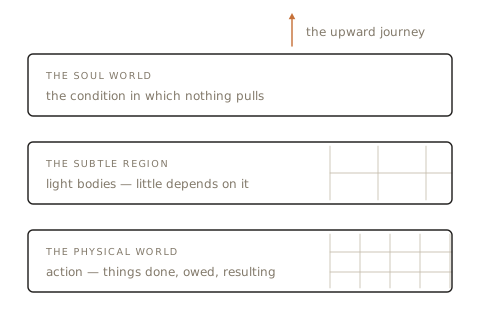
No consequence arriving, no account outstanding, no role to maintain, nothing owed in either direction. One teacher's phrase for it is a region of light and detachment and freedom, and the operative word of those three is the second one. It is not defined as a happy place. It is defined as an unattached one.
That is the home the feeling at the top of this chapter points at. The course's claim is that you came from there, that every soul did, and that the homesickness is not metaphorical.
What this chapter will not do
Now the honesty, before anything is built on it.
I cannot offer you evidence for the soul world. Nothing in this chapter is checkable the way chapter three's claims about attention are checkable, or chapter four's observation about how long anger lasts. It is a cosmology, you will either find it plausible or you will not, and a book that pretended otherwise would have forfeited the right to be believed anywhere else.
The course does offer something it treats as evidence, and you should know what it is and what it can bear. There is a published first-person literature of people who were medically very close to death and came back with an account — light, absence of body, the fading of the whole apparatus of personal story. The course points at it, and it is worth knowing that the pattern most often reported is not about scenery at all. It is that people come back saying they have to love more.
What that literature can support is a fact about testimony: a large number of people, across cultures and beliefs, report something convergent. What it cannot support is the metaphysics. The medical interpretation of those states is genuinely contested and I am not going to borrow authority I do not have. So nothing in this chapter rests on it, and if you discount it entirely the rest of the chapter still works, because the rest of the chapter is about consequences.
And one more thing this is not. The ascent described below — up through the clouds, out past gravity, beyond the galaxies, and then past those — is not astronomy. Nobody is claiming a destination that a sufficiently good telescope would find. It is a technique for getting the pulls to let go of you, and it works on the imagination the way a long exhale works on the chest. Judge it as a technique.
What it is for
So why is this in the course at all, given that it cannot be demonstrated? Because of what follows from it, and what follows is practical, immediate, and the best thing in this chapter.
If everybody came from one place, the differences are later than we are.
Not unreal — chapter four was clear that this teaching does not flatten anybody. Later. The distinctions that organise human life — language, nation, colour, sex, caste, class, the religion you were raised inside — all of them are things that happened after, to a thing that existed before them and will outlast them.
And here the course says something about ordinary human unkindness that I have not seen stated this flatly anywhere else. It traces the whole mechanism in one step:
Every criticism is a claim to be better.
Every complaint about a colleague, every judgement passed on a stranger's choices, every bit of commentary on how somebody is raising their children. Strip the content out and the function is identical in each case: I am above this. You already know this about other people. The chapter asks you to look at your own last three days of it.
Then the diagnosis of why we do it, which is the generous half and the true half:
We lost sight of our own worth, so we impose the lack on everybody else.
Nobody who feels securely valuable needs to arrange a hierarchy at dinner. The arranging is the symptom. And once you can see it as a symptom, two things happen at once: it gets harder to do, and it gets much harder to be wounded by somebody else doing it to you — because you can see where they were standing when they said it.
Why no two people see the same thing
The second consequence, and it dissolves more interpersonal friction than any other idea in the first week.
If souls entered this world at different times, then each one is carrying a different length of experience. Not better or worse. Longer or shorter, and differently composed.
Think of a party you arrive at late. The people who came at seven have been through two conversations, a crisis in the kitchen and somebody's bad news; you walked in at eleven. You are in the same room at the same party and you are at two different events, and if you argue with them about what sort of evening it is, you will both be right and you will both be baffled.
That is the course's account of why people cannot see what you see. Not stupidity, not bad faith, not even disagreement exactly — different lengths of road behind them. And the move that follows is a small and very serviceable one. Where you would normally conclude they do not get it, the available alternative is: they have not come to that part yet — or, just as often, and this is the half people forget: they came to it long before I did and I have not caught up.
Hold both directions of that and a startling amount of your commentary about other people simply stops having anywhere to go.
And the order matters, because it only runs one way. Treating other people with honour is not the first move; it is a consequence. Nobody manages it for long by effort. It arrives, more or less on its own, once you have stopped running a deficit on yourself — which is why this book spent two chapters on what you are before it said anything at all about how to treat anybody else.
What the course says happens at the end
The third consequence is the one the chapter exists to set up, and it requires saying plainly what the course holds about death.
Three things are in play: the physical body, a subtle body of light, and the soul. Death is the separation of the first from the other two, and what leaves is what chapter two was about — not a version of you, not your memory, you.
The course is unsentimental about this and it draws a sharp practical point from it:
Everybody realises what they are when they leave the body — and by then it is of no use.
The realisation is not the achievement. It is the default, available to everyone, arriving too late to be spent. The whole purpose of doing this while alive is that this is the only place where anything can be settled. You cannot work on a record from outside the body; you can only read it.
That is, I think, the most motivating sentence in the seven days, and it is also where this book's otherwise cheerful insistence on checkable results reaches its limit. I cannot show you that. What I can show you is what holding it does to a Tuesday.
The claim I have to put a fence around
The course also holds that your circumstances of birth were not random — that the family, the country and the body you arrived in follow from what was already recorded, and one teacher puts it as directly as this: your parents did not choose you; you chose them.
I am including it because it is in the teaching and this book does not quietly drop the parts that are awkward. But it needs a fence around it, and the fence is not optional.
What the claim is for. It is aimed at the sense of arbitrary victimhood that attaches to ordinary circumstance — being born in this country rather than that one, into this amount of money, with this body, to these people. The teaching's intent is that none of that is a cosmic accident that happened to you, and therefore none of it is grounds for either resentment or superiority.
What it may never be used for. It may not be used to tell anybody that they chose what was done to them. If you were hurt as a child, this teaching does not say you arranged it, consented to it, or had it coming, and anybody who tells you it does has taken an idea about the absence of randomness and turned it into an assignment of blame to the person with the least power in the story. Those are not the same claim and the second one is a misuse.
I would rather say that explicitly than let a sentence in a quiet chapter do damage on its way past. If this is the paragraph that decides you against the chapter's cosmology, that is a reasonable place to get off, and nothing else in the book depends on it.
A stay, not a possession
Here is the whole chapter cashed out, and it is one sentence.
If you came from somewhere and are going back, then everything here is a stay.
The hotel room you are in is not worse for being a hotel room. You can like it enormously. You can keep it beautifully — and the course has no patience with people who use this idea to stop maintaining the car. What changes is only the grip. A stay is enjoyed. A possession is defended.
And almost all the suffering attached to the good things in your life comes from the second posture rather than from the things themselves. Not from loving your family — from the quiet arithmetic of owning them. Not from the work — from the identity in it. You can test which one you are in by a single question: what would it do to me to lose this? The answer is not about how much you love it. It is about what you have decided it is.
The course's own image for this is theatrical: the actor comes from home, plays the part fully — not half-heartedly, fully, because a bored actor is no use to anybody — and then goes home. While the part is on, it is played. It is simply not mistaken for the actor.
And three sentences to carry, which the course gives as a set and which work best said exactly in this order:
I am a peaceful being.
What I came from is peace itself.
The place I came from is where peace is the condition, and I am going back.
At the end of this chapter
Study
Read the organisation's page on the soul again, at
brahmakumaris.org/concepts-and-conversations/soul, and then read Wheel of Life on the same
site, which is where the rebirth material sits. Read it for the specific claim it makes and the one
it does not: it says that souls return within their own kind — that human beings remain human
beings — and it is noticeably restrained about everything else.
And read it for the tone. You are looking at an organisation that has been teaching this for nearly ninety years and has had every opportunity to overclaim. Notice how often the pages say perhaps, and how the one page that deals with God opens by conceding that plenty of people think the whole idea is nonsense. An organisation's confidence level is data about the organisation.
What I could not do for this chapter. I have checked this book's claims against the organisation's own published material throughout, and for most chapters that works. For this one it does not, because the material is not of the checkable kind, and I want to be straight with you about where that leaves us: chapter six is the chapter you may reasonably hold at arm's length while running everything else. The practice below does not require you to have settled it.
The question to ask at a centre. Ask somebody who has been doing this for decades what they think happens at death — and then ask the better question: has believing it changed how you live now? That second answer is the only part of this subject that can be examined from outside, and it is worth hearing from several people, because they will not say the same thing.
Practice
Keep the minute, three times a day, and keep the sixty-second connection from chapter five once a day. That is now the standing practice and it does not change again for several chapters.
The new work is the ascent, and it takes about ninety seconds. Once a day, best done last thing at night:
Sit, settle, come in behind the eyes. Then let the attention go up — and let it go up in stages, because the staging is what does the work. The room. The building. The town with its lights on. The country, then the curve of the earth, then the dark with the earth small in it. Then past the planets, out of the galaxy, and then past the stars altogether, into light with nothing in it.
Stay there for a few seconds doing nothing.
Then — and do not skip this — come back deliberately, the same way, in stages, and open your eyes in the room. The return is part of the exercise. This is not an escape technique and the practice is spoiled if you use it as one.
And one audit, once a day, in a sentence. Name one thing you are currently holding as a possession rather than a stay. Not to give it up. Just to notice that you have decided something about it that you did not consciously decide.
Meditate
To read slowly, or record and play back.
I let the body settle. It is parked; it is breathing without me.
I come in behind the eyes. I am a point of light.
And I let the room go. Not leave it — let it go. The walls, the sounds, the hour of the evening.
I go up. The building, with the people in it. The town, lit and busy, with everyone's day ending in it. All of it still going on, and none of it needing me for the next minute.
Higher. The country. The weather over it. The earth from outside, with the line of the sunset crossing it slowly.
Higher. Past the planets. Out past the stars, and then past the stars.
Light, with nothing in it. Nothing pulling. Nothing owed.
I am from here. Before the name, before the language, before the family, before the country, before the body — I was already this, and I will be this afterwards.
There is nothing to settle here. Nobody is waiting for an answer. I am simply at home for a few seconds, which is a thing I have wanted all my life without knowing where to look.
And now I come back, because I have a part to play and it is not finished.
The stars. The earth. The country, the town, the building, the room, the chair. The body, which is mine to use and mine to look after.
I open my eyes. I am here on a visit, and I intend to be good at it.
What this should do for you, and by when
In the first week, the only honest thing to expect is relief, and you may not get it. For some people the ascent produces an immediate and startling physical release — shoulders, jaw, a long exhale that was overdue by about a decade. For others it is just visualising, and visualising is dull work. Both are normal; neither tells you anything yet.
By two or three weeks, the staging should get faster. What took ninety seconds starts taking thirty, and the drop-off point — the moment the pulls let go — stops needing the full itinerary. If that is happening, the technique is doing what techniques do, which is become shorter.
By a month, the result this chapter exists for, and it is about grip rather than insight:
Something you were holding tightly will be held more loosely, and it will not feel like a loss.
A plan that changes and does not wreck your week. A job you do not get and are odd amounts of fine about. Somebody's departure, a sold house, a thing you had decided was yours turning out to be on loan — and the surprise is not that you coped. It is that the coping cost less than it has historically cost you, and that you can tell the difference between liking something and owning it.
And a limit I want to be exact about, because this is where this kind of book goes wrong. None of the above applies to grief. If you have lost somebody, this practice is not a method for feeling less about it, the cosmology in this chapter is not a consolation you can apply on demand, and anybody who tells you that a sufficiently good meditator does not mourn is describing numbness and calling it detachment. Grief is the correct response to loss and it takes the time it takes. What this chapter can offer the bereaved is narrow and I will not inflate it: a few minutes a day somewhere the pulls are not, which is rest, which is not nothing.
What will not happen. You will not resolve the metaphysics, and you should not expect the homesickness to go away — people who have practised this for forty years still get it. What changes is that it stops being a vague ache with no object. It becomes a direction.
How to tell it is working. One question at the end of the day, honest, first answer only:
What did I treat today as permanent?
The job, the arrangement, the relationship, the body, the version of yourself you were defending at four in the afternoon. You are not looking for a confession. You are looking for the specific places where you forgot you were on a visit — because those are exactly the places where next week's suffering is being quietly manufactured.