Eyes OpenChapter 3 of 1716 min
The machine you are running
Sit still for sixty seconds and thoughts arrive. You know that; chapter one was mostly about not treating it as a defeat.
But watch the arriving a little more closely and something odd shows up. You did not write most of them. They are not the product of you deciding to consider something. They turn up fully formed, in your own voice, about topics you did not raise, and the first you know about any of them is that one is already underway.
If you are producing them, you are doing it somewhere you cannot see. And if you are not producing them, something else is — which raises the question of what that is, and whether you have any say in it.
That is this chapter. Not what you are — chapter two did that — but how you are built, and which part of it is actually yours to operate.
Three parts
The tradition says the soul has three functions. Not three pieces, in the way a body has organs — three things the one small thing does.
The mind: where thoughts happen.
This is the part everyone is already aware of, because it is noisy. It generates. It is doing it right now, underneath your reading. It does not stop, it cannot be ordered to stop, and chapter one asked you to give up wanting it to.
What is worth noticing is that the mind is not the author. It is closer to a stage. Things walk onto it. Where they walk on from is the third part, and we will get there.
The intellect: the part that decides.
Thinner, quieter, easier to miss, and it is the whole of your leverage.
The intellect is what weighs. It is the thing that looks at what the mind has just produced and says yes or no or not now — which to act on, which to let pass, which is true, which only sounds true. It is judgement, discernment, and will, all of which turn out on inspection to be the same muscle doing different jobs.
Everything you are going to get out of this book happens here. Not in having better thoughts. In getting better at choosing between the ones you have.
The record: what has been laid down.
Call it the record, or the grain, or — the tradition's word — sanskars. It is the accumulated residue of everything you have already thought and done, enough times, that it has stopped being something you do and become something you are.
And the record is not passive. This is the part most people have never been told. The record does not sit in storage waiting to be consulted. It generates. It pushes thoughts up into the mind, unprompted, all day, in the shape of whatever is written in it.
Which is where the odd observation at the top of this chapter comes from. The thoughts you did not author are coming from the part of you that was written by thoughts you did author, a long time ago, repeatedly, usually without noticing.
The loop
Put the three together and you have a machine, and it runs in a circle:
the record pushes up a thought → the mind runs it → the thought produces a feeling → the intellect either endorses it or declines it → what you do gets written back into the record
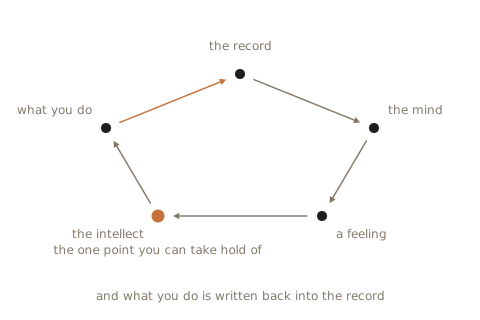
Everything about your inner life is somewhere on that circle. And the circle explains the thing that is otherwise baffling about trying to change: why you can know exactly what you ought to do, intend it sincerely, and find yourself doing the other thing before lunch.
You were working on the wrong part of the loop. You were trying to change the output while the input kept arriving from a record you had not touched.
Where you actually get a vote
Look at the circle again and notice how little of it is under direct control.
You cannot stop the record generating. You cannot choose what gets pushed up next. You cannot prevent a thought arriving, and you cannot stop a thought you have entertained from producing a feeling — that part is close to automatic.
You get one move, and you get it in one place. When something has arrived and is running, the intellect can decline to sustain it.
That is a smaller amount of freedom than most self-improvement assumes and a far larger amount than most people use. It is also the only place in the system where change can enter, and everything in this book is an attempt to make that one move more often and more skilfully.
But there is a catch, and it is the most useful sentence in this chapter:
A weak intellect does not choose. It goes along with whatever the mind sends it.
An intellect with nothing in it has no grounds for declining anything. If you have no clear idea what you are, what this is for, or what is actually true, then when a familiar miserable thought arrives there is nothing in you to rule against it, and it simply proceeds — and gets written into the record, and comes back stronger next week.
Which is why this course is half knowledge and half silence, and why that is not a design accident. Silence settles the mind. Knowledge furnishes the intellect. Do only the first and you get a calm person with no better judgement, who feels nice for an hour and then goes along with whatever arrives. Do only the second and you get a well-informed person who knows exactly what they should be doing while not doing it.
You need both, and they fix different organs.
Why the bad ones feel automatic
Here is the objection everyone makes at this point, and it is a fair one.
Negative thoughts come by themselves. Nobody has to practise despair. Why do I have to manufacture the good ones while the bad ones are supplied free?
Because you have already done the practice. That is the whole answer.
Think about any route you drive often. The first time you needed the whole of your attention — which turning, which lane, is this the one. By the twentieth time you arrive having thought about something else entirely, and the car got there anyway.
Nobody would call that a miracle. It is just what sufficient repetition does to a route.
Your habitual thoughts are the same thing. The reason a particular resentment, or a particular piece of self-contempt, arrives unbidden and perfectly formed is not that it is natural and the alternative is artificial. It is that you have run that route several thousand times and the alternative three times. Of course it is faster. It is a road, and the other one is a field.
This is good news in a way that takes a second to land. If the automatic ones got that way by repetition, then repetition is the mechanism, and the mechanism is available to you. The deliberate, clumsy, slightly embarrassing positive thought you have to force out today is not inferior to the effortless bad one. It is just younger.
Four kinds of traffic
Not all thoughts are the same kind of thing, and it helps to be able to sort them. The tradition uses four categories, and they are more useful than good-and-bad.
Necessary. I need to post that. The car is low. She finishes at four. The administrative traffic of being alive. Nothing wrong with it, and you cannot run a household without it.
Positive. Thoughts that rest on something — patience, affection, resolve. They cost nothing and leave you with more than you started with. These are the ones this practice is trying to manufacture deliberately until they stop needing to be manufactured.
Negative. Thoughts resting on anger, fear, envy, contempt. The distinguishing feature is not that they feel bad — some of them feel excellent at the time — but that they take something out of you and out of whoever is nearby.
Waste. And this is the category that matters, because it is the largest and the least noticed. Waste thoughts are not wicked. They are simply thoughts about things that cannot be affected: rehearsals of conversations that already happened and went differently; detailed preparation for futures that will not occur; the endless re-litigation of a decision that is finished.
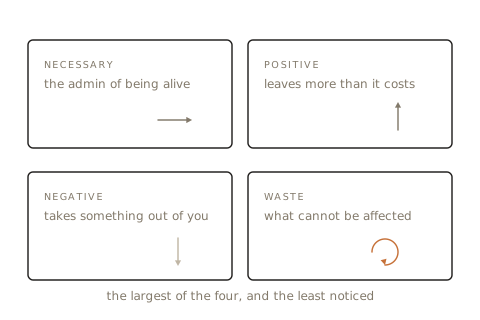
The test for a waste thought is a single question: is there an action at the end of this? If there is, it is necessary and you should go and do it. If there is not, you are using a working mind to operate on something that is out of reach, and you will get up tired having achieved nothing.
And notice how easily necessary turns into waste. I must remember to call the surgery is necessary. The ninth rehearsal of what you will say is not.
Feelings as the readout
You cannot watch the record directly. You cannot see what is written in it. But you can read the dial, and the dial is how you feel.
Which makes one question unexpectedly powerful, and it is the only technique in this chapter:
How do I feel, right now?
Ask it three times today. Not rhetorically — actually answer, with a word.
The answers sort into three, and all three tell you something:
A clear negative word — irritated, anxious, flat, resentful. Useful. That is the record reporting what is currently running, and naming it is most of the work. An unnamed mood runs your afternoon. A named one is something you are looking at.
A clear positive word — steady, interested, light. Also useful, and worth more attention than people give it. Notice what produced it; that is a route worth using again.
And "nothing, really" — which is the interesting one. Occasionally it means genuine equanimity. Far more often it means something is running that you have not admitted to, and the honest answer is some distance below the one you reached for.
The grain, and what other people see
One more distinction, because English blurs it and the tradition does not.
There is what is written in you — the private record, which is yours and largely invisible. And there is the disposition that comes out of it, which is what everybody else has been dealing with for years and has probably formed firm views about.
Those are two different things, and you have access to the first in a way nobody else does. Other people only ever see the second, and they will tell you about it if you ask, which is an uncomfortable and extremely efficient shortcut.
And it is worth being clear that the record is not a verdict. It is not your essence, it is not your character in the sense of your worth, and it is not fixed. It is the accumulated result of repetition. That is all it is. Which means it can be written over by exactly the thing that wrote it in the first place, slowly, in the same way, with the same tool.
A disposition is not a diagnosis. It is a tally.
A number you will see quoted, and should not use
You will come across the claim that a person has sixty thousand thoughts a day, often delivered with great confidence and sometimes with a percentage attached — so many of them negative, so many the same as yesterday's.
I cannot find a solid source for it, and I have looked. It circulates widely in this field, it is cited to "researchers" without a study attached, and I am not going to repeat it as fact here.
It also does not matter. The argument of this chapter does not need the number to be sixty thousand rather than nine thousand. It needs only something you can confirm yourself in a minute of sitting: that there are a great many, that you did not author most of them, and that they are not random.
I mention it because you will meet it, and because a book that quietly passed on an unsourced statistic would have no business asking you to check anything.
At the end of this chapter
Study
Read the organisation's own page on the soul again, at
brahmakumaris.org/concepts-and-conversations/soul — this time for one line you probably skimmed
the first time: the soul holds memories. That is the record, stated in four words.
And read Experience Raja Yoga, at
brahmakumaris.org/concepts-and-conversations/experience-raja-yoga, which is this chapter in
miniature and more forceful than anything here. Look for the sentence about becoming aware of each
thought and then ruling it — and note that it gives you a nanosecond to do it in. That is the
intellect, and that is the size of the window.
The thing to ask a teacher, if you get to a centre. Not what are sanskars — they will tell you. Ask the harder one: how do I know the difference between a thought I chose and a thought that arrived? It is the question this chapter cannot fully answer on paper, and the answer is usually a practical one.
Practice
Keep the minute, three times a day. No change to it this week.
The new work is outside the minute, and it is a question.
Three times today — morning, middle, and before you sleep — stop for ten seconds and ask:
How do I feel, right now?
Answer with one word. Out loud if you are alone, in writing if you will forget. Do not analyse it, do not trace its causes, do not try to improve it. Name it and move on. The entire exercise is the naming.
If the answer is nothing or fine, wait five more seconds and ask once more. The second answer is usually the true one.
And one sorting task, once a day. Catch a single thought in flight and put it in one of the four boxes — necessary, positive, negative, waste. One thought. Not a survey of your mind; just one, labelled, and then let it go.
If you want the written version, keep a line a night. A date, and your three words. By the end of the month you will have something no amount of reflection would have given you, which is evidence about your own weather.
Meditate
To read slowly, or record and play back.
I let the body settle. I let the sounds be where they are. I come in, in stages, to the point behind the eyes.
I am a point of light. Small, and still, and here.
And from here I can watch what the rest of me is doing.
There are thoughts arriving. There have been all day. Most of them I did not write — they came up out of something older, along routes I wore in myself, years ago, without knowing I was wearing them in.
I am not those thoughts. I am the one they are arriving at.
Some of them are useful. Some of them are only old. I do not have to answer every one of them.
Now I put one thought down, deliberately, in the quiet — not borrowed, not arrived, chosen:
I am a peaceful being, and I can choose what I think.
I let that go as far as it goes. Not arguing with it. Not checking whether it is true yet.
I am the one who decides. Not every time. Not yet. But more often than yesterday, and that is the whole of the work.
And when I get up, I take the one who decides with me.
What this should do for you, and by when
In the first week, you will not feel calmer. You will feel busier — and this is the correct result, so do not let it stop you.
What happens when you start asking how you feel is that you notice how much has been going on unobserved. People reliably report that the practice has made things worse, and it has not. The weather was always like that. You have put a window in, and the first thing a window does is show you the weather.
By two weeks, you should be able to answer the question with a real word, quickly, most of the time. That is a skill and it is not trivial; a large number of adults cannot do it and have substituted fine for an entire inner vocabulary. If fine and tired are still your only two answers at a fortnight, keep going — they are the last two words to break down.
By a month, the thing this chapter exists for:
You will catch a thought while it is running, and decline it.
Once or twice. Not reliably, not for the big ones. A familiar grievance will start up, and somewhere in the first few seconds you will recognise the route — this one again — and put it down, and feel faintly surprised.
That is the single move the whole system turns on. Everything else in this book is practice for it.
What will not happen. The thoughts will not stop arriving, and the record will not have changed yet. A month is nothing against decades; what changes at a month is your relationship to the traffic, not the traffic.
Nor will you be able to do this when it matters most. Early on, the move works on small irritations and fails completely on the two or three subjects that genuinely have you. That is normal and it is not a sign you have the wrong practice. Those are the deepest grooves; they come last.
How to tell it is working. The tradition gives a test, and it is the best one I know — run it at the end of a day, honestly, taking the first answer:
Do I feel settled, or do I feel worn out?
Settled means the day ran mostly on necessary and positive thoughts. Worn out — with nothing physical to explain it — means it ran mostly on waste and negative ones. The exhaustion is the reading. It is not telling you the day was hard. It is telling you what you spent it thinking.
Run that for two weeks and you will have a chart of your own mind that no amount of introspection would have produced. And a chart is the beginning of a choice.