Eyes OpenChapter 7 of 1717 min
The method, and why the eyes stay open
Six chapters in, you have been given almost no technique.
That was deliberate. Technique is the most attractive part of this subject and the least important early on, and a book that opened with posture and hand positions would have had you managing a procedure instead of finding out what you are. So the instruction has been as thin as I could make it: sit, settle, put one thought down, get up.
But thin instruction has a shelf life. There comes a point where the vagueness stops protecting you from fussiness and starts being the thing in the way — where you sit down, and nothing happens, and you genuinely do not know whether you are doing it wrong or whether this is simply what it is like.
This is the chapter for that. Everything in it is method, and the course's own version of this session is not a lecture at all but a laboratory: the room sits five or six times in an hour, unfolding its legs between attempts, so that the body never becomes the obstacle.
One disclosure first. The course organises all of this with a mnemonic — a word whose letters give you the steps in order. I have not reproduced it, because the mnemonic is the teacher's own invention and not the organisation's syllabus, and this book has a rule about that. What follows is the method underneath it, in plain order. If you ever take the course from a teacher, you will meet their version and recognise every step.
All of it is one of three things
Before the steps, the map — because it retroactively explains everything this book has had you doing, and nobody ever gives it to beginners.
Every practice in this tradition is one of exactly three movements:
One: inward. Going into what you are and experiencing its own qualities. Chapters two, three and four were this. The minute is this.
Two: upward. Taking the attention to where it came from and to what is there. Chapters five and six were this. The sixty-second connection and the ascent are this.
Three: outward. Radiating what you have to the world, deliberately, as an act. This book has not asked you to do any of it yet, and it is chapter nine's subject.
That is the whole repertoire. Whatever you are doing in a sitting, you are somewhere in those three, and when a practice feels pointless it is very often because you are attempting the second without having done the first — which is the single most common mistake and has its own section below.
The setting, briefly
Four things, and then I will stop talking about furniture.
Somewhere reasonably quiet, but do not wait for silence; silence is not coming.
Not in the dark. This is distinctive and the course is firm about it. A darkened room invites the state that looks like meditation and is actually drowsiness, and the whole method is built against that. Light, or at least not dark.
Back straight, nothing strained. Chair, floor, cushion, doesn't matter. Hands wherever they are comfortable and will stay. The only real requirement is that in four minutes' time your body will not be the loudest thing in the room.
And the eyes slightly open — which is the chapter's main business and gets its own section.
Step one: withdraw, in stages
Here is the part that makes the difference between a method and an intention.
You do not go inward in one move. You come in through a sequence of narrowing circles, and the staging is not decoration — it is the mechanism.
the road outside, with its traffic and people → this building, and the sounds in it → this room → the body sitting here → the breath → and then what is behind the eyes
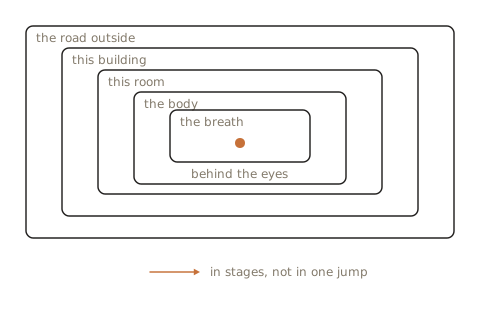
Each one for a few seconds. You are not shutting anything out — that was chapter one's point and it still holds. The sounds on the road stay exactly where they are. You pass through them on the way in, acknowledging each ring and leaving it behind, the way you walk through a house to a back room without needing the house to disappear.
Try it once right now, reading. Road, building, room, body, breath, behind the eyes. Most people find that the arrival is noticeably different from the arrival they get when they simply sit down and aim at themselves.
Step two: the runway
The second most useful image in the whole course, and it explains a failure you have probably already had.
An aircraft does not leave the ground from standing. It uses the runway first.
Chapter five asked you to send a thought out and then receive. If that has felt like talking into a cupboard, here is very likely why: you were attempting the upward movement without the inward one first. You went from your inbox to the Supreme in one step, from a body-conscious standing start.
The rule is unglamorous and absolute. You get into soul consciousness first, every time, however briefly — then you go up. The runway is not optional and it is not a different practice; it is the first thirty seconds of the same one. Expect no result from the second movement until the first has happened.
Step three: the attention, and then the picture
Now you are in. Put the attention on one thing.
The breath first, if you need a rung — not controlling it, just noticing that it is happening without you. Then move it off the breath and onto what is noticing.
And then the step that most people leave out, which is why most people's practice stays flat: give it a picture.
A point of light behind the eyes. Small, steady, with the quality of a star rather than a bulb. Light above, and light here, and the one receiving the other.
Here is why it matters, and it is the most practically important sentence in this chapter:
A thought you only think stays a thought. A thought you picture, and feel, becomes an experience — and experience is the only thing in this practice that changes anything.
You already know this from the other direction. The thought that was humiliating does nothing much on its own; the same thought with the scene restored and the feeling attached can take your whole evening. The machinery is identical. You have simply never aimed it anywhere good on purpose.
And a necessary accommodation, which no version of this course I have seen bothers to make. A substantial minority of people cannot form mental images at all. If you are one of them — and you will know, because every guided meditation you have ever tried has asked you to picture something and you have quietly wondered what everybody else is doing — you are not excluded from this. Picture is one route to feeling and not the only one. Use the felt sense instead: the physical sensation of being small and still behind the eyes, of something steady, of warmth arriving from above. Or use one word and let it carry the feeling. The destination is the experience, not the imagery, and anybody who tells you otherwise has confused the road with the place.
Step four: take; do not ask
The posture correction that governs every sitting after this one, and it is a small sentence with a great deal of consequence.
You are not begging.
A great deal of inherited religious instinct turns a practice like this into petitioning: asking, pleading, bargaining, hoping to be heard, with an undertone of if I am good enough this time. Chapter five already took the price out of this relationship. What follows from that is a different physical attitude in the chair.
You are taking what is already being given, as a matter of ordinary right.
The course's picture for it is light falling on you from above, like a lamp aimed down, and you sitting inside the circle of it — not reaching up for it, not earning it, just sitting in the part of the room where it already is.
And the matching image for why nothing is ever wrong at the other end:
A broadcast does not stop because your radio is off. It does not stop because you are tuned badly, either. To mistune, hear static, and conclude that the station has gone off the air is an error about where the problem is.
Switching on is sitting down. Tuning is everything else in this chapter.
The count, and the one
A practical shape for the whole sequence, which the course gives as a number: 0, 0, 0, 1.
The first zero is the body. I am in it. I am not it. Set it down — it will go on breathing.
The second zero is everybody and everything in today. The people, the work, the errands, the message you have not answered. Not solved. Set down.
The third zero is the rest. The story, the name, the roles, the version of yourself you have been maintaining since breakfast.
And then the one. One thing, undivided, with everything else out of the way.
The reason given for the three zeros is worth having, because it is not arbitrary: what you are turning towards has no body, no speech and no action, so you reduce the physical content of your own attention to meet it. You cannot tune to nothing while carrying everything.
And the reason it is one rather than several is the plainest argument in the course for why this relationship is worth having at all: every other relationship you have is subject to revision. The people change, the roles change, your own body changes under you. This is the only item on the list that is not scheduled to be replaced.
Why the eyes stay open
Now the teaching that most distinguishes this tradition from almost every other meditation you have encountered, and the one that beginners resist hardest.
You meditate with your eyes open. Not wide — half-open, lids lowered, the gaze resting unfocused on one point a little below the horizontal. Blinking is fine. It is, as the course points out, exactly what you do for forty-five minutes at a screen.
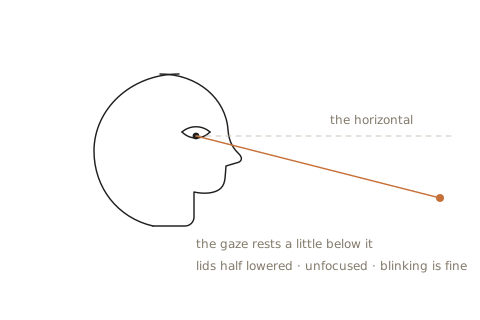
Five reasons, and they get better as they go.
One. Closed eyes produce more thoughts, not fewer. Shut them and watch what happens to the traffic. The course's claim is that opening them halves it, and in my experience of asking people, this is the reason that convinces the sceptical fastest, because they can test it in ten seconds.
Two. It is the only version that transfers to a life. This is the real argument. If you can only reach the state with your eyes shut, in a quiet room, in a particular position, then you have acquired a hobby with a venue. Your eyes are open for sixteen hours a day. The entire point is a practice that runs while you work, cook, queue, and listen to somebody who is annoying you — and a method that collapses the moment you open your eyes cannot become that, however deep it goes.
Three. It is practical. Someone walks in. With closed eyes there is a scene — the surfacing, the explanation, the faint air of having been interrupted at something holy. With open eyes you simply look up. Nobody has to know, and nothing has to be defended.
Four. It is the only defence against the comfortable counterfeit. This is the sharpest thing in the session, and it should be read twice by anybody who has ever come out of a long sitting feeling wonderful:
Some people close their eyes, sit for twenty minutes, and report that it was deeply peaceful. That was not peace. That was sleep with a better name on it.
Meditation in this tradition is an alert state. Chapter one established that it is not relaxation and not emptiness; this is the enforcement mechanism. If your practice cannot survive being awake, it was not the practice.
Five — and this is the one that makes it teachable: you have already been doing it all your life.
You have sat with your eyes open, so absorbed in thinking about one person or one problem that somebody spoke to you and you did not hear it. Someone came into the room and you did not notice. You have driven a familiar route and arrived with no memory of the journey.
That is sustained concentration with the eyes open, and you did it without instruction.
You are not being asked to acquire a new faculty. The faculty is installed, it has been running unsupervised for decades on whatever happened to grab it, and the whole of this method is pointing the existing equipment somewhere on purpose.
At the end of this chapter
Study
Read Experience Raja Yoga at
brahmakumaris.org/concepts-and-conversations/experience-raja-yoga. You have been sent there twice
before; this time it should read completely differently, because you now have the method and the
page is the method's justification. Look for the claim about self-rule — being aware of a thought as
it arrives and then ruling it, inside a nanosecond, acting on it or discarding it. That is
chapter three's lever and this chapter's technique, in the organisation's own words.
And read it for the sentence that draws the boundary, which is the most ethically careful thing on the whole site. The power is over yourself. Just yourself. Other people's lives are their own. And on the subject of your parents: they did what they did, well or badly, and that time has passed. A practice that gives you power over nobody but yourself is a practice that cannot be turned into a weapon, and it is worth noticing that the organisation says so on its front shelf.
The mnemonic. As I said at the top, the course has one and this book does not reproduce it. If you want the version with the letters, that is a reason to take the course from a person — it is free, it runs in thousands of places, and the mnemonic is genuinely a good one.
The question to ask at a centre. Ask somebody to watch you do it. Not to teach you — to look at you for two minutes and tell you what they see. How open your eyes are, where your gaze has landed, whether your face is working. There is no way to get that from a book, and it is the one piece of feedback that reliably shortens the first six months.
Practice
This is the chapter where the practice changes shape, so here is the whole thing in one place.
Three times a day, three minutes — up from one. The structure:
- Sit. Back straight, nothing strained, not in the dark. Eyes half-open, gaze resting on one point.
- Come in, in stages. Road, building, room, body, breath, behind the eyes. Ten to fifteen seconds. Pass through the sounds; do not fight them.
- The runway. I am a point of light. Small, still, here. Stay until it is not just a sentence — however long that takes, and if it takes the whole three minutes, that was a complete practice and you do not go on to step four.
- Then up, if you got there. Light above; you sitting in it. Take, do not ask. Twenty seconds of receiving and nothing else.
- Get up and go. No grading.
The counting version, when the mind is loud. Some days step two will not hold. Use the zeros: set down the body, set down everybody in today, set down the rest, and then one thing. It is the same sequence with handles on it.
And one thing out in the world, once a day. Do the first three steps with your eyes open in a place where you would normally never attempt it — at a desk, on a bus, in a queue, in a waiting room. Thirty seconds. Nobody will be able to tell, and the first time you discover that is the moment this becomes a practice rather than a ritual.
Meditate
To read slowly, or record and play back. Eyes open throughout.
I am sitting here, and my eyes are open, and that is correct. I am not going anywhere I would need to be absent for.
Outside there is a road. Traffic, somebody's voice, the ordinary noise of a day that is going on without my supervision. I let it be exactly as loud as it is.
And I come in. This building. The rooms of it, the people in it.
This room. Its air, its light, the chair holding me.
This body. Sitting. Breathing. Doing it without instruction, the way it has every day of my life.
And behind the eyes, where I have been all along. I am a point of light. Small, and still, and here.
I stay. Not thinking it — being it. Still. Light. Nothing required.
And when that is steady, I let the attention go up. There is light above me, like a lamp turned down towards where I am sitting, and I am inside the circle of it.
I am not asking for anything. I am sitting where it falls.
It comes in. Steadiness. Strength, which I did not generate. I take it, as a matter of course.
A few seconds more here, in the light, awake, eyes open, entirely present in this room.
And then I move. Carrying it, not remembering it.
What this should do for you, and by when
In the first week, open eyes will feel wrong and your practice may seem worse. Expect this. The mind has learnt that closed eyes mean off duty, and taking that away produces a few days of feeling exposed and busy. There is also a specific illusion to prepare for: it will seem as though you are having more thoughts than before. You are not. You are awake, and you can see them.
By two weeks, the staged entry should be collapsing. The full sequence — road, building, room, body, breath, point — starts arriving in ten or fifteen seconds instead of forty, and on good days you will find yourself behind the eyes almost as soon as you sit, with the stages running in the background like a gear change you no longer think about.
By a month, the result this chapter exists for, and it is the most useful single capability in the book:
You will enter the state on purpose, in under thirty seconds, somewhere inconvenient.
A waiting room. The five minutes before a difficult meeting. A corridor. Eyes open, nobody aware, no scene made — and you will come out of it with something you did not have going in. That is the whole of what this method is for. Everything else is preparation for being able to do it there.
What will not happen. You will not be able to do it mid-argument. Not at a month, probably not at six. The state is enterable from neutral and from mildly unpleasant; it is not yet enterable from inside a surge, and attempting it there and failing tells you nothing about your practice.
And one honest exception. None of this works properly when you are very tired. The method is built against drowsiness — light, open eyes, upright back — but no technique defeats a genuine sleep debt, and sitting down to meditate at the end of a four-hour-sleep week is not discipline. It is an attempt to meditate your way out of needing sleep, and it does not work. Sleep, then practise. The tradition has a great deal to say about early rising and nothing at all in favour of exhaustion.
How to tell it is working. One question at the end of the day, honest, first answer only:
Could I get there today when it was inconvenient?
Not did I feel peaceful. Not was the sitting good. Could you, at some point in an ordinary day, in a place not designed for it, with your eyes open and your shoes on, arrive behind your own eyes on purpose? When the answer is yes two or three days a week, you have the method, and you can stop thinking about technique for a long while.