Eyes OpenChapter 16 of 1717 min
The four subjects
By now you know a great deal about this.
You could explain what the soul is, how it is built, where the tradition says it came from, what karma actually records, why the eyes stay open, and what the eight powers are. If somebody asked you at a dinner party you would acquit yourself well.
And the tradition has a name for that person, and it is not a compliment. You would be a scholar of this material — somebody in whom it has been stored rather than installed.
The test it offers for the difference is the cleanest thing in the whole course:
You hear that it is going to rain, so you take an umbrella with you. That is knowledge.
Then it rains. Do you walk through it thinking about how much it is raining — or do you open the umbrella?
Everybody reading this has, at some point in the last fifteen chapters, walked through a shower holding a closed umbrella while thinking about meteorology. Knowing is one subject out of four, and on its own it changes nothing.
The four
| Commonly called | What it is | The verb | |
|---|---|---|---|
| 1 | gyan | knowledge | to know |
| 2 | yoga | connection with the source | to experience |
| 3 | dharna | inculcation | to do |
| 4 | seva | service | to share |
I have given the traditional names once, in their common English spellings, because you will meet them if you ever go to a centre. The verbs are what matter. Know, experience, do, share.
And the order is argued rather than asserted, which is unusual and worth following. You cannot go to the source before knowing what you are — chapter seven's runway, appearing again as a curriculum rather than a technique. Knowledge makes the connection possible; the connection turns information into experience; experience becomes conduct; and conduct, the course claims, becomes service by itself, without being organised into a project.
The diagnosis
Here is the use of this chapter, and it is diagnostic before it is instructional. Each subject has a characteristic failure, and you can identify yours from the list.
All knowledge and no connection produces the scholar. Articulate, well-read, able to explain the cycle to anybody who will sit still, and not noticeably different from a year ago. This is the failure mode of people who read books, which is to say of you and me.
All connection and no conduct produces the person with a lovely practice and an unchanged life. The sittings are deep, the chair is pleasant, and chapter five's counterfeit is running undetected: judged by Tuesday, nothing is happening.
All conduct and no knowledge or connection produces willpower with no fuel. The grinding from chapter thirteen: being better by force, which works for about eleven days and then produces a collapse the person treats as a moral failure.
And all service with none of the other three produces the most recognisable religious casualty there is — the person doing an enormous amount for everybody, running on empty, slightly bitter, and unable to say when they last sat down. Service is the fourth subject because it is the consequence of the other three, and taken on its own it is simply work.
Find yours. Nearly everybody is strong in one, competent in one, and essentially absent in two. This is the most useful ten minutes available to you at this stage of the book.
Why the word is yoga and not meditation
A small distinction with a large consequence, and the tradition prefers the first word deliberately.
Meditation names an event. Something you did, for a length of time, in a place, which began and then ended. You can count them.
Yoga names a connection — and the thing a connection has, which an event does not, is continuity. It is either on or off; it does not have a duration.
Which reframes the entire practice. The three minutes are not the thing. They are where the connection is re-established after you dropped it — and the ambition is not longer sittings. It is a shorter gap between them, and eventually no gap at all, with the sittings becoming a place where you notice what has been running all along.
The dark room
Now the best image in the session, and it corrects something almost everybody does.
You walk into a dark room. Do you stand in the doorway asking who turned the light off? Why it is always dark when you arrive? Whether somebody did this deliberately?
You put the light on.
And the application is the whole of this tradition's attitude to your own weaknesses:
Do not investigate the darkness. Add light.
You have spent a certain amount of your life on the forensics of your own faults — where the impatience came from, which parent, which year, why it is always you. Some of that is genuinely useful and I am not going to tell you self-knowledge is worthless. But it is not the move that changes the room.
This is chapter four's increase the peace instead of reducing the fault, chapter eight's drill, and chapter thirteen's two columns, all arriving at the same instruction from different directions. It is the most repeated idea in the entire course, and the repetition is the tradition telling you which single thing it would keep.
And the light, specifically, is the first two subjects: knowing, and connecting. That is what you put into a dark room. Not analysis.
Churning
The method attached to the first subject, and it is better than reading more.
Take one thought — one sentence, one idea, one of the three points from chapter fifteen — and ask three questions in order:
- What does this actually mean? Not what it reminds you of. What it says.
- How would this get into my life? Specifically, this week, in a named situation.
- What am I about to face — and what thought do I want to arrive with?
That third question is the one nobody asks and it is the engine of the whole method, because it turns study into preparation. You know what Thursday contains. You know which conversation is coming, which meeting, which family member. Churning is deciding, in advance, in the quiet, what you intend to be holding when you walk into it.
The course's claim for this practice is specific and I think accurate: when you churn, a great many fears and unnecessary thoughts get cut off — not addressed, cut off, because they turn out to have been occupying space that now has something in it.
Dharana, and the lotus
The third subject is the hardest and it has the oldest image in India attached to it: the lotus, which is in the water and not of it.
What the course does with it is more interesting than the usual reading. The question is not how to stay clean. It is: can you leave? There are weak habits around you, people in poor states, a general atmosphere you did not choose. Can you simply get out of it?
You should not — and if you do, leaving becomes the habit, and you will do it again, and you will be doing it for the rest of your life.
And then the correction this whole book has been building towards, which the course states plainly:
Detachment does not mean leaving. It does not mean the mountain, the robe, the reduced obligations, the smaller life. The tradition's own argument against that is devastatingly practical: if you leave, their thoughts come with you anyway. You will be sitting somewhere quiet having exactly the same arguments in your head, with the added disadvantage of no longer being useful to anybody.
Be with everyone. Be in the world. Do the duty. And be detached.
So where does the weight come from? The course names it in one word, and it is chapter twelve's word: my. My child, my family, my husband, my team. People believe that possessive is love. It is not. It is attachment, and it is the specific thing that makes duty heavy — not the tasks, the ownership underneath the tasks.
And then the definition of the real article, which is the single sentence I would keep from this chapter:
Take the expectation out of the love. What is left is the real thing.
Not take the love out. The expectation. What remains is a regard for somebody that does not depend on their performance — which means you are no longer altered by what they do, and can therefore be of some actual use to them.
Seva, and how little it requires
The fourth subject is service, and the tradition's version of it is much smaller and much more available than the word suggests.
It does not require words. Chapter nine's mental service counts. Cleaning the room you are in counts — the course says so explicitly, on the grounds that it changes the atmosphere of the place, and I notice that the organisation's own health page recommends tidying a bathroom.
And the main form is automatic. Live the first three subjects and service happens as a by-product, because what you radiate in chapter nine's weak sense reaches everybody in the room whether you organise anything or not.
Which means there is no stage of this at which you are too busy, too junior, too unqualified or too tired to do the fourth subject. You are doing it now or you are not, and it has very little to do with volunteering.
Two hard claims, and what to do with them
The course makes two statements in this session that I am not going to smooth over.
The first is benefit finding. The instruction is that in the first second of any trouble, the thing you reach for is: there is good in this; this is an account settling; this will certainly change. The claim is that the mind stabilises immediately, and in my experience of trying it, on ordinary trouble, that is true and the speed is the point.
But guard it. Benefit finding is something you do to your own misfortune in the first second. It is not a thing you say to another person about theirs — there's a reason for everything is one of the cruellest sentences available to a bereaved parent — and it is not an instruction to decide that a bad thing was good. The claim is that something can be extracted. Not that nothing was lost.
The second is harder. A passage read out in this session says that a person who has understood this teaching cannot cry in any situation — that the drama is beneficial, that happiness is what was given, and that there is therefore nobody to cry to.
I will tell you how I hold it, and you may disagree. Read as a statement about protest — the why me, the bargaining, the long night of arguing with the universe — it is consistent with everything in this book and it is a high standard honestly stated. Read as a prohibition on weeping, it would be harmful, and I do not believe the tradition practises it that way: I have watched people inside this organisation grieve.
So: chapter six's position stands unchanged. Grief is the correct response to loss and it takes the time it takes. If any teaching, including this one, leaves you dry-eyed at a funeral by effort, what you have built is not detachment.
The real test
And finally, the passage the entire course is aimed at, which comes from the other teacher and which I would put at the front of this book if it were not better placed at the end.
Your success in this is not that you sat in a corner with your eyes closed and it went well.
The proof is observed elsewhere, and the list is precise: your character becoming more decent · your personality getting softer and simultaneously stronger · your love expanding beyond the people who earned it · your clarity improving · your purity doing things you did not expect · and your peace being able to soften somebody hard.
That is the proof. Nothing else is. Not the quality of your sittings, not your vocabulary, not your knowledge of the ages, and not how long you can hold a point of light.
And one morning diagnostic to go with it, which is the most practical sentence in the session: if you wake up heavy, that is a signal about the night before and about what you are doing with your spirit and your body. You are not supposed to wake up heavy. Something upstream of the alarm needs attention.
At the end of this chapter
Study
This chapter's study is not a page. It is the diagnosis.
Write the four verbs down the side of a sheet — know, experience, do, share — and give each one a mark out of ten for the last month. Be honest; the marks are for you. Then answer one question: which two are nearly absent, and what would the smallest possible version of the weaker one look like this week?
Not the stronger one. You will want to work on the one you are already good at — that is the whole mechanism this book has been describing since chapter four.
Then, if you want a page, go back to the first one the book sent you to: Experience Raja Yoga,
at brahmakumaris.org/concepts-and-conversations/experience-raja-yoga. You have read it three times
and it will read differently again, because it is written for somebody at exactly your current
position: it is almost entirely about the third subject.
The question to ask at a centre, and this is the best one in the book: ask somebody what they do on the days when they cannot be bothered. Everybody has them. People who have practised for decades have them. What you want is their actual answer, because the answer to that question is the entire difference between a practice and an enthusiasm.
Practice
This is the chapter where the whole thing becomes a timetable, and both courses give the same one independently, which is how you know it is the tradition's and not a teacher's preference.
The daily shape:
- Morning. Three minutes, properly — staged entry, runway, then up. This one is not optional; the tradition puts enormous weight on the first thing you do.
- Evening. Three minutes.
- Before sleep. Three minutes, plus the four-line chart.
- And between them: the hourly pause. One or two minutes, six times, spread through the working day. Both courses call it traffic control, and the instruction is the same: stop, come in behind the eyes, one sentence, and go on.
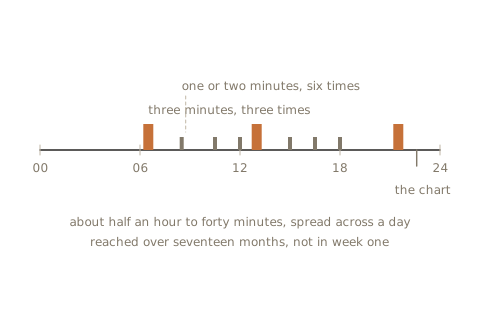
The hourly pause is the new work and it is the most consequential change in this book. It is also the one most likely to fail, so make it concrete: attach each one to something that already happens. The kettle. The lift. The walk to the car. Between two meetings, before you open the door. Not six alarms — six existing moments.
And the churning, once a day, on one thought: what does it mean, how does it get into my life, and what am I about to face and what do I want to be holding when I get there. Three or four minutes, and the third question is the one that pays.
Then one piece of the fourth subject, daily, with no words. Tidy something, or send one minute to somebody, or do the unglamorous thing nobody will attribute to you. It does not count more if anybody knows.
Meditate
To read slowly, or record and play back. Eyes open.
I come in through the stages. Road, building, room, this body — holding its position, breathing without me. Behind the eyes.
I am a point of light. Still. Here. Connected, and the connection did not go anywhere while I was busy.
(pause)
I am not in the dark asking who turned the light off.
I am putting the light on. That is all this is. Not an investigation. An input.
(pause)
And I look at what is coming. Tomorrow has things in it — a conversation, a person, an hour I am already slightly braced against.
So I decide now what I will be holding when I walk into it. Not a strategy. A state.
I am a peaceful being. I am not short of anything. I do not need them to be different.
(pause)
And the one I love who has been costing me the most.
I take the expectation out of it. Not the love — the expectation. The requirement that they be a particular way for me to be all right.
I am not claiming them. I never could. We are two separate things, playing parts, for a while, near each other — and that is not less than what I wanted. It is what was actually on offer, and it is a great deal.
(pause)
One more breath. And then I get up, and I do the thing — because knowing it is not the umbrella.
What this should do for you, and by when
In the first week, the hourly pause will fail about four times out of six, and that is the normal rate. Nobody manages six on day one. Two is a successful day, and the pauses you miss are not worth a single second of self-reproach — they are just missed.
By two or three weeks, the thing to watch for is the pauses starting to arrive unprompted. You will be standing at the kettle and find that you have already come in behind your own eyes without deciding to. That is the second subject becoming continuous rather than scheduled, and it is the clearest sign in this book that something structural has changed.
By a month, the result this chapter exists for, and it is the only result that has ever mattered:
You will open the umbrella.
Once, visibly, in a situation that used to go the other way. The thing you have known for fifteen chapters will be the thing you do, in the three seconds available, without a rehearsal. And afterwards you will notice that you did not have to be convinced — the knowledge was simply available as conduct, which is what the third subject is.
What will not happen. You will not become consistent. The timetable will survive about eleven days and then a difficult week will take it apart, and you will rebuild it, and that will happen repeatedly for years. Both courses are explicit that this is the sweet difficulty of the whole thing: the practice is not hard, and doing it all the time is.
And you will not be able to tell whether it is working by how you feel. That is what the real test above is for. If you want to know, do not consult your sittings — ask whether anybody has remarked that you are easier to be around. That is the measurement, it is external, and it is nearly impossible to fake.
How to tell it is working. One question at the end of the day, honest, first answer only, on line three of the chart:
Which of the four did I actually do today?
Not how it went. Which ones happened. Most nights the answer will be one or two, and the value of writing it is that after a fortnight you can see your own lopsidedness in your own handwriting — and nobody in the history of this practice has ever corrected a lopsidedness they could not see.