Books
Fifteen books. Four of them are the same argument at four ages — an adult's, an old person's, a fourteen-year-old's and a four-year-old's — because a way of steadying yourself that only works once you are old enough to read philosophy is not much use to someone sitting exams, and no use at all to a child at bedtime.
Who Was in It is the middle of the first book re-cut for somebody who came looking for time management, and it says on its own back page that if you already own The Inward Singularity you should not buy it. What You Are Paying For makes the adult's case a second time, in the language of money rather than physics, for a reader who would put down a book that began with entropy. Hold Closer takes the same practice outward, to what a frictionless world costs the person living in it. Larger turns the argument outward, to somebody who is not scattered at all but has built a great deal and cannot find himself inside it. Nothing Reaches Him is a novel, and asks the question the others cannot: whether a man who has become unreachable is steady, or simply absent. Unannounced is the ninth, and it is about the eight before it: where they came from, and why none of them says so on the cover. And The Thing It Landed On came after all of them, and is the smallest: one question, asked fourteen times. What Nobody Chose is about the thing you were using to find out where you stood, and who is choosing it now. And Before You Ask is its other half: not what reaches you, but what gets decided for you before it ever becomes a question. The Hour Afterwards turns away from both of them: not what is reaching you and not what is being decided for you, but what is left when you step out of the whole record for two minutes — and whether the hour after it shows anything. And Rooted Expansion is the odd one out and says so on its own first line: it is about firms rather than people, it cites its evidence as it goes, and it is the only book here that could sit on a business shelf without anybody being misled.
Free to read · Eleven chapters
The Inward Singularity
Become the Prime Mover in a High-Entropy Universe
A book for people who feel mentally scattered, overextended and pulled in too many directions. It describes that condition in the language of physics, and turns it into practices: eleven chapters, eight inner skills, and a three-part daily rhythm.
There are two editions. The plain-language edition is written in everyday words. The deep version keeps the original voice, with the equations, the diagrams and the Raja Yoga terms in full.
Free to read online, and free to download as a PDF or for an e-reader.
There is also an audiobook: the whole plain-language edition read aloud, an hour and a half, free and with no sign-in.
The plain edition can be ordered from Bookshop.org, where the money goes to independent bookshops rather than to Amazon.
Read the book Listen to the audiobookBuy the paperback on AmazonBuy the plain edition at Bookshop.orgSee it on Goodreads
Twelve chapters · Not published yet
Who Was in It
Your calendar is fine. That is the problem.
Ten of its twelve chapters are from the book above, in its Plain-Language Edition. The book says that about itself on a page at the back, rather than in a note nobody reaches — and it says the rest of it too: if you own The Inward Singularity, do not buy this. You have the middle of it already.
It is here for the reader who would never have picked that one up. Somebody with a calendar that works, blocks that hold and a system they are not looking to replace.
It is ten past six and you have done everything you said you would. The blocks held. The proposal went out at four. Nobody is waiting on you — and you are finished. Not satisfied-finished. The other kind.
A calendar allocates the day. It was never asked who would be in the room once the block began, and no system can answer that, because a system can only put you somewhere.
There is nothing to install here, and that is the argument. The only measure in it is one no tool can produce: not how many hours you got, but what the hours left behind — which, unlike how an afternoon felt, somebody else can see. Eight weeks. If nobody who lives or works with you notices anything, the claim is wrong and the book says so.
Two of the twelve chapters were written for it and appear nowhere else: the first, on why a good system cannot reach this, and the last, on what an afternoon costs you afterwards.
Twelve chapters in four parts, about eighty-eight pages. Not published yet. There will be a paperback, a hardcover and a Kindle edition.
Eleven chapters · Ninety-six pages
What You Are Paying For
and how to stop
The argument of The Inward Singularity made a second time, for a reader who would put a book down at the word entropy. It is not an edition of that book. It is a different one, with none of its vocabulary, written in the language of an ordinary bank account.
You are not scattered because you are weak or badly organised. You are paying for forty things you are not using: a conversation left open, a decision deferred to Thursday, an argument still being rehearsed in the car. None of them is large. All of them are live, and each one takes a little every day whether you touch it or not.
The book turns on one sentence. Closing an account is not the same as finishing it. A closed account is not a solved problem — it is a problem that is no longer billing you, and that is something you can do tonight about a thing you will not finish this year.
Eleven chapters, ninety-four pages. Nothing in it takes more than ten minutes, and the last chapter asks for nothing at all.
Buy the paperback on Amazon Buy the hardcover on AmazonBuy the Kindle edition

Ten chapters · Eighty-nine pages
Larger
without becoming smaller
For capable people who are overwhelmed not by failure but by success that has come off the ground.
A man in his fifties has eleven things and every one of them is going well. Standing at an event while somebody reads the list aloud, he cannot recognise the man being described. Nothing on his list failed. Nothing is going to. What failed is the relationship between the achievements and the person carrying them — and it took about a decade, and nothing looked wrong at any point along the way.
It will not ask you to be smaller. It does not say that ambition is noise, or that the answer was always a quieter life.
The book turns on one distinction. Scattering and expanding look identical from outside, and they are opposites. One is a failure inside the hour. The other is a failure across the years, and the years are not watching.
Ten chapters: what paid for the last decade, how to tell a new branch from a second tree in the one conversation where it is still free to know, how much a person can carry without coming off the ground, and the number almost nobody writes down. Each ends with something to do, usually in under twenty minutes. There is no system in it, and no streak to lose.
Buy the paperback on Amazon Buy the hardcover on AmazonBuy the Kindle edition

Twenty-two short chapters · Large type
The Weight You Can Put Down
One thing at a time, in an ordinary evening
It is a quarter past nine in the evening. Nothing happened today — and that is not the reason it is heavy.
For somebody old, often alone, often inside a family, who has been carrying the same few things for forty years: the life that did not happen, the people they blame, and the blame they have kept for themselves.
It will not tell you that you did your best. It will not tell you it was not your fault. It will not ask you to forgive anybody.
What it does is take one thing at a time, and set out the difference between putting it right — which needed somebody else — and putting it down, which never did.
Nothing in it takes longer than tonight. There is no practice in it, nothing to do daily, and nothing to be behind on. Twenty-two short chapters, set in large type, and you can open it anywhere.
Eighteen short chapters
Hold Closer
As the outward expands without limit, does the inward have to pull harder — or only closer?
Imagine a week without power. Not a catastrophe: a fortnight of repairs, of queues, of nothing you normally reach for being there. What is left is whatever you are when nothing reaches you, and for most of us that is an open question rather than a comforting one.
Your phone is not a tool you pick up. It is part of how you think, how you remember and how you settle yourself — and you will not find out how much until it stops.
The capacities that would carry you through that week — to tolerate, to withdraw, to discern, to face, to co-operate — cannot be installed in an emergency. They are built by occasions, and the occasions are leaving ordinary life quietly, one convenience at a time. And the children being raised inside it will have no memory of the occasions at all.
Eighteen short chapters. It does not ask you to give up your phone, and it does not predict a collapse.
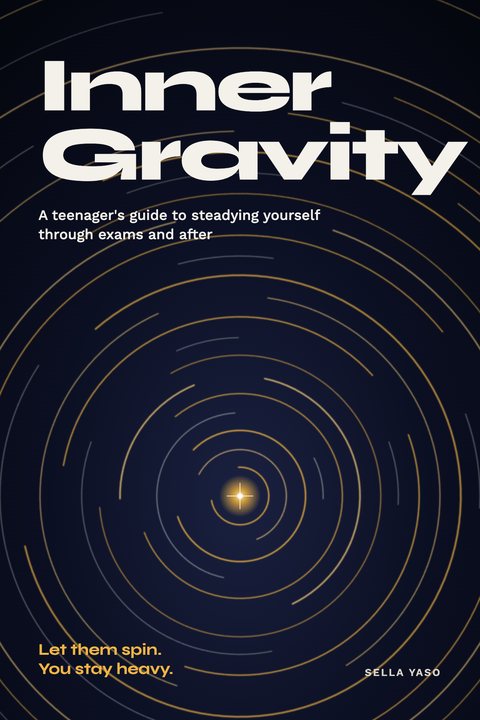
Ages 14 to 16
Inner Gravity
For fourteen- to sixteen-year-olds
The same argument, written for someone in the middle of their GCSEs. Its claim is that being wiped out at that age is not a character flaw but a mechanical problem: attention pulled in four directions at once, cancelling itself out. Four people pushing one shopping trolley from four sides. All that effort, and the trolley does not move.
Thirty-one short chapters, most of them four minutes to read. Three daily anchors that take sixteen minutes between them. A thirty-day tracker and a one-page toolkit built to be photocopied and stuck on a wall.
It does not promise better grades, and it does not moralise about phones.
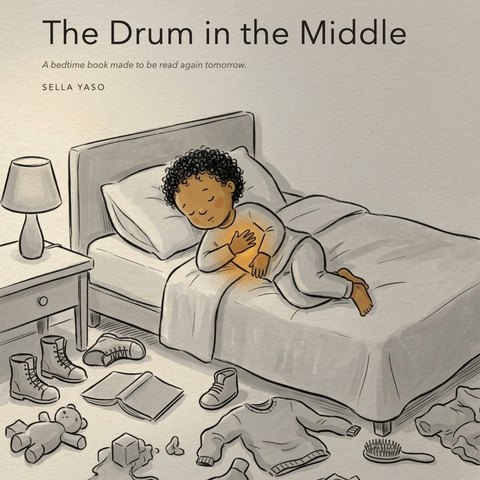
Ages 4 to 6 · Free to read here
The Drum in the Middle
A bedtime book made to be read again tomorrow
For four- to six-year-olds, and the same argument as the others with every word taken out of it. The day is over and your arms are heavy — and that is only because things were pulling at you all day. So they go down on the bedroom floor, one at a time, until the floor is covered and you can see how much you were carrying. Then the bed takes the weight.
Some things are not for the floor. Those come up, and get said out loud.
Thirty-two pages. The last page is a note for the grown-up reading it, including why the drum is never named and what I will carry it until the morning is a promise to do.
The pictures are a draft. They are not final and not consistent from page to page; they are here so the book can be read while the illustration is being settled.
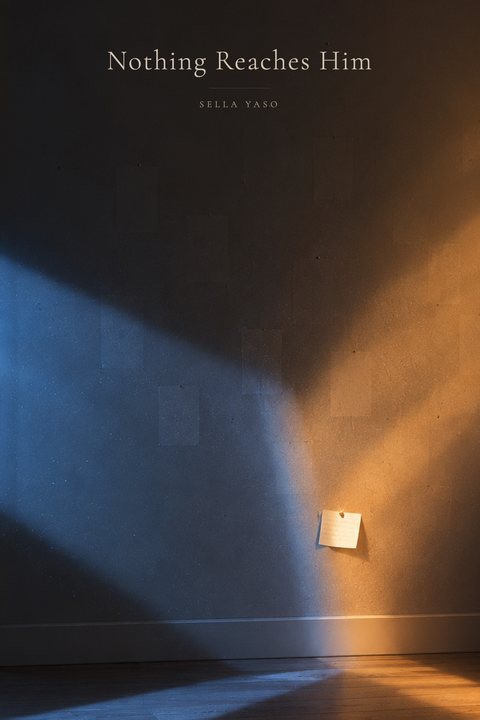
A novella · About two hours
Nothing Reaches Him
A novel
A man says the same sentence to himself every night for three years and never once notices he is saying it. Then his company fails, and in a box he was supposed to have opened he finds his grandfather's hand-painted snakes and ladders board, and a note: the snakes are not punishments, and the ladders are not prizes.
So he starts choosing his sentences, and across eight months he becomes, precisely and to the letter, the man he keeps telling himself he is. Slower. Steadier. Very hard to upset.
Nothing reaches him. The book does not tell you at the end whether that is what he wanted or what he lost.
A novella — about two hours.
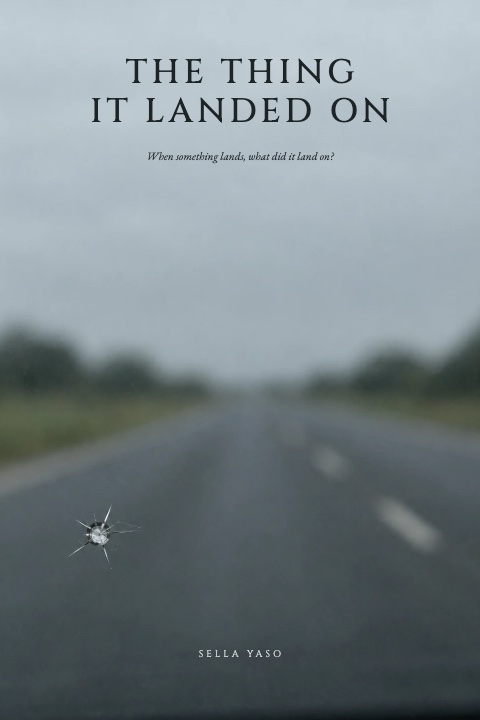
Fourteen short chapters · Free to read
The Thing It Landed On
When something lands, what did it land on?
Somebody says your part of the work could have been tighter. Eleven words, in a meeting with another fifty minutes in it. At a quarter to ten that night you are still arranging the sentence you should have said.
The same week somebody told you your spelling was a disgrace. You laughed and fixed it.
The difference is not how bad they were. A thing can only land on you where you are standing — and the places accumulate, the way a house accumulates furniture, until you live among them and have stopped seeing them as objects at all.
This is a book about one question you can answer in four seconds. It asks nothing else. There is no programme, no vocabulary to learn, and nothing in it to be ashamed of — it is careful to say that thinking less of yourself is going the wrong way, not the right one.
It does not promise that you will stop minding. It offers you the half hour after the meeting back.
Free to read, in full, here. Fourteen short chapters, an hour and a half altogether, and no chapter needs the one before it in the same sitting. There is a paperback and a Kindle edition as well, for anybody who would rather hold it or read it away from a browser — and there is nothing in either that is not on this page.
Read it here Buy the paperback on AmazonBuy the Kindle edition

Thirteen short chapters · Seventy-six pages
What Nobody Chose
What used to reach you by accident
Almost everything you know about yourself arrived by accident. A man you dislike says eight true words in a meeting, on his way to making a different point, and you spend four years unable to put them down. You get on the wrong bus and walk back through a street you had lived twenty minutes from for three years and never once entered.
Nobody picked any of them, and that is what made them useful. You find out where you are standing by what hits you — and nothing aimed at you on purpose can tell you that.
Something now sits between you and the week. It is good at it, it is not lying to you, and it is selecting. The remark that would have landed does not arrive. The question you would have sat with is answered before you have finished asking it. The thing you would have found in the fourth result is on the first.
It is not a book about misinformation, or elections, or whether the machines are dangerous. And it does not pretend that selection is new: attention selects, mood selects, where you were born selects, and so do family, language, school and whatever happened to you at nine. The argument is about what is different now, and it is built so that you can disagree with it precisely.
It ends with less than you would want, and says so. There is nothing to install and nothing to give up, and no decision anybody could take that would make the next ten years different. What is left is the only thing in the book that has not been handed over — you still flinch. Something still arrives, something still answers, and the answering was not supplied by anybody.
Thirteen short chapters, about an hour and a half. Seventy-six pages, in paperback, hardcover and Kindle.
Buy the paperback on Amazon Buy the hardcover on AmazonBuy the Kindle edition
Thirteen short chapters · Not published yet
Before You Ask
When the question is answered before it is put
Almost everything you know about yourself, you found out doing something you were not qualified to do. The job you could not do, and took anyway because the alternative was eleven more years of the one you had. The move that was wrong in its reasons and right in its result, and you still cannot separate the two. The thing you turned down at twenty-six for reasons you can no longer give.
Decisions are made for you now, and they are made better than you would make them. That is not in dispute, and the book concedes it in chapter two, in full, with the figures. Your tariff is right. Your route is right. The twenty-five minutes of low-grade dread that comparing four of anything produces are simply gone, and nobody is handing those back.
So the loss is not accuracy. A filter hides a path and the path is still there. A decision closes it, and there was never a fork. What is missing is not the option — it is the interval: the irritable, unproductive fortnight in which you would have had to find out what you wanted before you could answer.
And would you have taken the other path anyway? No. You would not have. And it would still have told you something — because you do not have to take the path for the fork to tell you where you are standing. You only have to stand at it.
It is not a book about deciding everything yourself, which is a worse life and it says so. There is one practice, once a month, and it is deliberately small. It will make some of your decisions worse, and that is the mechanism rather than a side effect.
Thirteen short chapters, about an hour and a half. Not published yet. There will be a paperback, a hardcover and a Kindle edition.

Sixteen chapters · Not published yet
The Hour Afterwards
You got out of the vehicle. Did anything change?
You are moving through time at one second per second and you have never had a choice about it. The wish to go back is not really a wish about time. It is a wish to be somewhere other than where the vehicle is now, which is why the people who want it most are having the worst year of their lives.
There is a way out, and it is not forwards and it is not backwards. It is out. Everything you call yourself is the log: the country, the work, the marriage, the illness, the year it went wrong, the thing you are good at, the thing done to you at nine. All of it is a record of where the vehicle has been. None of it is the one who was in it.
The move takes two minutes, and the two minutes are not the evidence. The first version of this book's test was not a test at all — somebody who sits for two minutes and finds nobody there concludes he did it badly, not that the book is wrong, because failure and incompetence look identical from the inside. So the claim is put somewhere it can lose. Get out of the vehicle. Then drive. Did the hour that followed go differently, in a way somebody who does not know you did it could describe? If nothing downstream changes, the book is wrong, and your own report of the two minutes does not rescue it.
It also argues with its own genre on one point. Getting out is the famous half. Coming back is the half that counts — the shortest chapter in the book is the one the whole thing is built on, and the twelfth is a portrait of a woman who did the first half reliably for fifteen years while her daughter learned to ring her father instead.
And the car is real, and it was issued. Nobody picked it. None of this is permission to treat it as something to be set down when it stops suiting you, and that misreading is guarded against early and in the text, not in a note at the back.
Sixteen chapters in four parts, about two hours. A hundred and two pages. Not published yet. There will be a paperback, a hardcover and a Kindle edition.

Nine short chapters · Not published yet
Unannounced
where the other eight came from
There is a page at the back of every one of the books above, about two hundred and fifty words long, that almost nobody reaches. This is that page at the length it deserves.
The eight are one book written eight times, and not one of them says on its cover where it came from. This one does. What I was given and by whom; what I did with it; why the name is kept off eight covers and printed on one page inside each; what travels out of a tradition and what does not, and what the version in those books is missing.
It is for somebody who has finished one of the others and wondered what they had just read. If you have not read one, very little here will land, and nothing in it is a secret you are missing — the eight are complete on their own.
Nine short chapters. One address.
Free to read in full, here. There is a paperback and a Kindle edition as well, because a book that reaches nobody helps nobody — but nothing in it is behind either of those.
For owner-operators · Not published yet
Rooted Expansion
Building a firm that grows with AI without being owned by it
This one is not like the others on this page, and it is worth knowing that before you start it. The thirteen above are about a person. This is about a firm, it cites its evidence as it goes, and nothing in it asks you to take anything on trust.
Your firm cannot be late any more. Nothing is dropped, the invoice is correct, the quote arrives in seven minutes, and every instrument on your desk reports that the firm is well. None of them is lying. They are measuring the thing that used to break.
For most of the history of small firms, taking on more than you could govern announced itself inside a fortnight. Something was late. A client was dropped. The warning was crude and loud and it was the only one anybody got. That alarm has been automated away. The condition it was warning about has not.
It is not an argument for using less of it — a well-rooted firm can carry far more automation than anybody has told it. But the brake that used to stop a firm taking on more than it could govern was the price, and the price has gone to almost nothing.
Four owner-operators carry it: an agency that went from fourteen people to four at the same revenue, whose founder can no longer say what it is for; a sixty-person heating contractor who installed dispatch, quoting and bookkeeping and still cannot take four weeks off; a solo founder shipping at two in the morning for the two-hundredth night running; and a sixty-three-year-old accountant who has taken the same fortnight every August since 2011 and cannot remember the terms of three acquisition offers.
Each chapter ends with one thing to do once — ten minutes, or twenty, and in the last case four years. No system, no streak, nothing daily. Then an appendix of ten business models for the AI era, ranked by durability for a firm of one to fifty people, each with real firms, real figures and the way it fails, and every number carrying its source and the kind of source it is.
Two of the findings it would most like to use are refused, because they did not replicate. One is printed although I would rather it were not. It will not make you rich and it will not make you faster. It tells you what is funding the push, and the date it stops.
Ten chapters in three parts, about a hundred and twenty pages. Not published yet. There will be a paperback, a hardcover and a Kindle edition.