Eyes OpenChapter 12 of 1718 min
The cycle of time, and the drama
There is one question that costs more human hours than any other, and you asked it recently.
Why.
Why is he like that. Why does she speak to me that way. Why did this happen to me, this year, when I had finally got everything arranged. Why are they like this about money, about their mother, about the smallest possible thing at the worst possible moment.
Notice two things about that question. The first is that you have asked it hundreds of times and it has never once been answered. The second is that you did not actually want an answer. If someone sat down and gave you a complete, accurate causal account of why your colleague is the way they are — genetics, childhood, three specific humiliations, a decade of reinforcement — you would not feel better. Because the question is not a request for information. It is a protest.
This chapter is the tradition's way of retiring it, and the doctrine it uses to do that is the largest and most contested thing in the whole system. I will give it to you straight, including the parts I cannot defend.
Whatever is eternal is cyclical
Start with the small claim, which is almost an observation.
Nothing that genuinely lasts runs in a straight line. Day into night into day. The four seasons, in order, again. Water from the sea to the cloud to the river to the sea. Every one of those is permanent, and not one of them is linear. What is permanent repeats; what runs in a straight line ends.
The tradition holds that exactly three things are eternal — the soul, the Supreme, and matter — and that therefore the arrangement they are involved in is a cycle rather than a story with an ending. Souls come into bodies and leave them, and the whole thing turns.
As a piece of reasoning it is thinner than it looks: cycles existing in nature does not establish that history is one. But hold it for a moment, because the use that is made of it is better than the argument for it.
The play
The image is a theatre, and it is worked out carefully:
| The actors | souls — every one of them |
| Home | where they come from and return to, between performances |
| The stage | this world |
| The lights | the sun and the moon |
| The run | one evening's play is two or three hours. This one runs five thousand years, and then begins again |
And here is what it is for — the practical payoff, which arrives in one line:
If everybody is playing a part, the question why has no work to do.
You do not watch a play and demand to know why the villain is being villainous. He has the villain's part. You do not instruct the actor playing him to speak his lines like the hero's; the evening does not work that way and nobody in the audience is confused about it.
Transfer that to your colleague, your brother-in-law, the person who runs the committee. The course's claim is not that their conduct is acceptable. It is that asking why is a category error, and that the hours you spend on it are the clearest waste in your whole mental economy.
And why the question comes back anyway
But it does come back, five minutes later, and the course names the reason precisely — which is the part that makes this more than a nice image.
Attachment.
Specifically, the possessive form of it. My brother. My team. My husband. The word my, used not to indicate a relationship but a holding — the person understood as something of yours, which therefore ought to conform, and whose failure to conform is therefore an offence against your property.
You can watch this in yourself with great precision. The why only fires at people you have filed as yours. A stranger behaves appallingly on a train and you think what a piece of work and go back to your book. Your sister does one-tenth of it and you are awake at midnight constructing the case. Same conduct, entirely different bill — and the difference is not love. It is ownership, which chapter six distinguished from a stay.
So the practice here is not stop asking why. You cannot stop a protest by deciding to. It is: find the ownership that the protest is coming from, which you can usually do in about four seconds once you know to look.
What you can actually do about somebody else's bad part
The course's answer is short, and after chapter nine you already have it. For a person whose part is going badly — the relative making a mess of their life, the friend in the middle of something you can see and they cannot:
You can wish them well, and you can send them what you have.
That is the list. It is not a long list and it is not meant to be consoling; it is meant to be accurate. You cannot act their part for them, you cannot write their lines, and the enormous amount of energy you are currently spending on wanting them to be different is not a form of help. It is a form of commentary.
And the thing you probably want permission to do instead — intervene, insist, explain it to them again — the course does not forbid. It simply does not count it as the practice. Say the thing once, kindly, if it is yours to say. Then the two items above are what remains, and the second one is available at any hour and costs nothing.
Variety is not a defect in the production
One correction before the hard part, because it closes a door that this material opens.
The play needs the differences. A bouquet is beautiful because the flowers are not the same flower. An orchestra works because the instruments disagree. Difference is not damage in the arrangement, and it is not something the practice is supposed to resolve into uniformity.
That matters because a reader could take the last few chapters — one origin, one home, the same kind of thing behind everybody's eyes — and arrive at a flattened world in which everybody ought to end up the same. Chapter four already refused that, and the drama refuses it again from the other side: a cast in which everybody has the same part is not a play.
Now the four ages, and then the problem
The cycle is divided into four, named for metals, in descending order of purity: golden, silver, copper, iron. We are in the fourth.
And the teaching is much better when you hear what the metals are actually describing, which the courses are explicit about: they are states of consciousness as much as they are periods of time.
Golden. Built, in one teacher's version, from jewellery. Pure gold is soft — you can bend it with your hands. So the golden state is flexible, unmixed, and strong at the same time: it moves without being forced, it is not harsh, it is not stubborn, and nothing about it is stony. That is a far more interesting description of a high state than happy.
Silver, then copper — where it starts to go. And the mechanism offered is not a fall from grace but something closer to entropy, which is the honest and generous version: nothing stays at a hundred percent. Babies do not remain babies. And the key observation, which you can check in yourself: the record of your own innocence is still in you. It is simply not activated most of the time.
And the way the decline begins is the part worth underlining. At the copper stage the problem is about two percent. Not enough to notice. Not enough to be alarming, or to produce a crisis, or to make anybody change anything — and that is precisely why it grows, undetected, for a very long time, until it is the ninety-eight percent and is simply called how things are.
Iron. Now. Whatever you make of the chronology, consider the state description on its own terms and against your own week.
The chronology, and what I am going to do about it
The cycle is given as five thousand years, repeating identically.
I am not going to pretend that this is compatible with what is known about the past. It is not. The archaeological, genetic and geological records describe a human story vastly longer than five thousand years, and no amount of sympathetic reading reconciles the two. If you came to this book from a scientific education, that is the sentence you have been waiting for since chapter one, and there it is.
And I am not going to drop the teaching either, because this book's job is to give you the tradition as it actually is rather than a version with the awkward parts removed, and because something quite interesting happens when you look at how the tradition's own teachers handle it.
They teach the ages primarily as states. Not exclusively — the chronology is held — but the weight of the actual instruction, in both of the courses I worked from, falls on what a golden state is like, what the two percent looks like when it starts, and what it is to live in the iron one. The organisation's own website, on this subject, does something equally telling: it says the matter is a deep discussion in itself and sends you to the free foundation course rather than arguing it on the page.
So here is my position, stated once and not revisited. Everything in this chapter's practice runs on the states. The flexibility of the golden state, the two percent, the exhaustion of the iron one, the retirement of the question why — none of it requires a date. If you hold the chronology, nothing here contradicts you. If you cannot hold it, you lose no part of the practice, and I would rather tell you that plainly than have you quietly discard the whole tradition over a number.
The seam
One more piece of the doctrine, because the practice leans on it.
Between the end of one cycle and the start of the next there is a junction — a seam, which the tradition treats as its own age and sometimes calls the age of diamond. Its claim is that we are in it, and that its defining feature is not chronology but availability: it is the period in which the connection in chapter five is open.
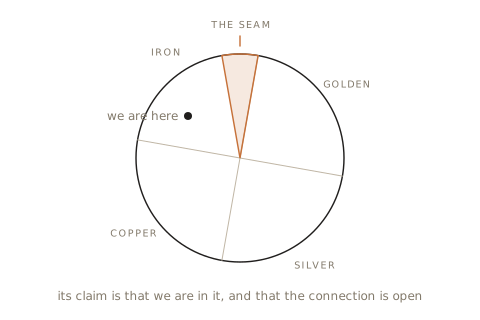
The argument offered for why now is worth hearing even if you discount it, because it is an argument rather than an assertion: both things are increasing at once. Harm is increasing — and so are intelligence, capability and discovery, at the same speed. And at the same time, visibly, far more people are taking an interest in interior life than were twenty years ago, including people with no prior disposition towards it. Both at once is held to be the indication. A lamp burns brightest as it goes out. It is darkest at three in the morning.
And there is one piece of this that is not a prediction at all but an experiential claim you can test, which is the part I would actually stake something on:
Living from the low state is exhausting, and it cannot sustain itself.
Spend a week watching people who run on contempt, suspicion and grievance — including the week you last did it yourself. It is tiring in a way that nothing else is tiring. Whatever you conclude about ages and cycles, the observation that darkness is self-depleting is available to anybody paying attention, and it is the whole reason the course expects the direction of travel to reverse.
And on heaven and hell, the tradition is more down to earth than its reputation: they are not locations elsewhere. The soul experiences both of them here, in a body, and the names describe conditions of this world at different points in the cycle rather than destinations after it.
The guard
Three misuses, each of which I have met.
The drama is not a reason to do nothing. A part played badly is still played badly, and nothing in a script argument excuses conduct. If you find yourself saying it is all a play at the moment somebody needs you to act, you have found the laziest possible use of a serious idea.
And it is never said about somebody else's suffering. That is just their part is in the same family as they must have done something from chapter eleven, and it has the same effect: it turns a teaching about your own composure into an excuse for your own indifference. Suffering is not less real for being in a story.
Nor is any of this a prediction you should act on. People have rearranged their lives around imminent-ending readings of material like this — sold things, abandoned plans, stopped studying for examinations. Nothing in this chapter justifies that, the timing of large claims is exactly what nobody has access to, and a practice that makes you worse at Thursday is not spiritual progress.
At the end of this chapter
Study
Read the organisation's page on the cycle, at
brahmakumaris.org/concepts-and-conversations/wheel-of-life. It names the idea by its Sanskrit term
and dates the concept's appearance in the written record — in both Indian and Greek sources in the
middle of the first millennium BCE — which is a useful reminder that this is one of the oldest
contested ideas in philosophy rather than a recent invention.
Read it for the boundary it draws, too, because the page is specific where popular belief is vague: this tradition holds that birth happens within one's own kind — humans remain humans — and it says so in distinction from schools that teach otherwise. That lines up exactly with what both taught courses say, and it is the sort of narrow, falsifiable-sounding commitment that tells you an organisation has thought about its own position.
And notice what it does with the hard part. It calls the subject a deep discussion in itself and sends the reader to the free course at a local centre. An organisation that declines to settle its largest claim on a web page is behaving better than most.
The question to ask at a centre, and it is the one I would most want to hear answered: how do you hold the five thousand years alongside the archaeological record? Ask it respectfully and ask it directly. You will get a range of answers, some of them unsatisfying, and at least one person will tell you honestly how they personally sit with it. That answer is worth more to you than any page.
Practice
The standing practice is unchanged. Three minutes, three times a day, eyes open, staged entry, runway first; the upward journey and the sending in one of them; a minute whenever you hear of trouble; the four-line chart at night.
The new work is to find the ownership under one why.
Take the complaint you have made most often in the last year about one person. You know the one; it has a standard phrasing by now and the person you say it to has heard it more times than they have let on.
Then, once, in writing, answer three questions:
- What exactly am I protesting? In one sentence, without the history.
- What would I have to stop owning for this to stop costing me anything? Not stop loving. Stop holding.
- What is actually mine to do here — the one thing I can say once, kindly, if it is mine to say; and then the wishing well, which is always available?
Then, every day for the month, the small version. When the why fires, ask one question instead: whose part is this? If it is not yours, you are commentating. Four seconds, and then back to your own lines.
And one additional thing in the chair. Once a day, in one of the three minutes, hold the golden state rather than a sentence about yourself: flexible, unmixed, strong, not stony. Ten seconds of trying to be the shape of that — chapter ten's method, applied to a condition rather than a statement.
Meditate
To read slowly, or record and play back. Eyes open.
I come in through the stages. Road, building, room, this body — breathing, holding its position, not where I am. Behind the eyes.
I am a point of light. And I am an actor, and I am in the middle of a part.
I look at today's scene. The people in it, each one with their own lines, their own length of road behind them, their own two percent that started somewhere they have long forgotten.
And one of them whose part is going badly.
I am not going to ask why tonight. I have asked it for years and it has never once answered.
I do not write their lines. I never did.
So I do the two things that are mine. I wish them well — plainly, without conditions. And I send them what I was given, which cost me nothing and is not running short.
(pause)
Now my own part.
Flexible. Not stubborn, not stony, not braced. Strong without being hard — the way something pure is soft and still does not break.
Unmixed. One thing, not six things arguing.
(pause)
This scene is not the whole play, and it is not the ending, and nothing in it is permanent — including the part of it I am currently dreading.
It is late in the evening and the lamp is bright.
One more breath. Then I get up, and I go and play my own part, which is the only one I have ever been cast in.
What this should do for you, and by when
In the first week, the only result is a count. You will discover how many times a day the why fires, and it is a larger number than you think — for most people somewhere between four and twenty, with two or three names taking nearly all of it. Collecting the count is the week's work. No attempt to stop it yet.
By two or three weeks, the substitution starts landing. Whose part is this? arrives in the first few seconds often enough to break maybe a quarter of them — and what you will notice is not calm. It is the recovery of a specific amount of time. People put it at twenty minutes to an hour a day, which is the most concrete return anywhere in this book.
By a month, the result this chapter exists for:
One recurring complaint will drop out of your vocabulary.
Not resolved. Not forgiven, necessarily. Retired — because you located the ownership under it and found that you had been protesting the non-conformity of something you had filed as yours. The person will not have changed. The complaint will simply have stopped being interesting, and the people who live with you will notice before you do.
What will not happen. You will not stop minding. The why about the two or three things that genuinely matter — the betrayal, the parent, the illness — will keep firing and should not be expected to yield to a four-second question. And you will not be at peace with the state of the world. Nothing in the cycle doctrine is designed to make the news tolerable, and if it makes you comfortable about other people's suffering, see the guard.
And one caution specific to this chapter. The material here is the kind that invites a person to start explaining the world — ages, seams, which scene we are in, what is coming. That conversation is almost entirely free of practice. If you find that you have begun telling people about the cycle and have stopped doing the three minutes, the chapter has gone to your head instead of your day, and the remedy is to stop talking about it for a month.
How to tell it is working. One question at the end of the day, honest, first answer only, on line three of the chart:
Did I ask why today — and did I get an answer?
The second half is the whole point, and after a fortnight of writing no in the same handwriting every night, the question starts firing less. Not because you have become wise. Because you have accumulated evidence against the habit, in your own hand, which is the only form of evidence that has ever changed anybody's behaviour.