Eyes OpenChapter 14 of 1717 min
The tree of religions
You have had this conversation and it went badly.
Religion comes up — at a table, in a car, with somebody you like — and within about four minutes two reasonable adults are defending positions that neither of them chose, in a tone neither of them uses about anything else. Nobody learns anything. Both leave slightly worse off. And if you are honest about it afterwards, you were not defending the truth. You were defending something that felt like your own skin.
One of the courses names the mechanism in three stages, and it is exactly right:
attachment to what the religion means to me → ego, which follows from the attachment → and then defensiveness — insecurity, competition, and a quiet need for my interpretation to be the one that wins
Notice that the content never enters it. The sequence runs identically whatever the religion is, and it runs in atheists about atheism. The subject is not the problem. The holding is.
This chapter is the tradition's picture of how all of this came to exist, and the picture's main virtue is that it makes the argument unnecessary.
The tree
Both of the courses I worked from draw the same diagram, independently, in two languages, and the organisation publishes its own version — so this is syllabus rather than illustration, and it can be taught in anybody's words.
| Part | What it is |
|---|---|
| The seed | the source — the Supreme, in chapter five's sense |
| The roots | those who take directly from the source, without an intermediary |
| The trunk | the roots acting together: one undivided people, before any of the divisions |
| The branches | the religions, each appearing in its own period |
| The twigs | the divisions inside each religion — and the divisions inside those |
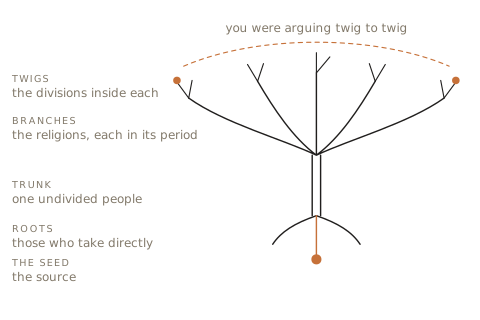
Read it from the bottom and it is a history. Read it from the top down — twig, branch, trunk, root, seed — and it is a diagnosis of the argument you had in the car.
You were arguing twig to twig. Not even branch to branch. Two people a very long way out from the trunk, each holding a position arrived at by a specific sequence of historical accidents, each experiencing that position as identity.
And the organisation's own page adds the observation that makes the diagram alive rather than botanical: the parts of a tree are connected. What happens in one part travels. Its gloss is that each thought and action sends a ripple outward — and that if you find yourself distressed by the state of the world's news, you now know why.
Why the branches keep appearing
Here is where this material is much better than its reputation, and much better than most religions' accounts of each other.
The tradition does not treat the arrival of a new religion as a corruption, a heresy, or a competitor. Its account is closer to supply meeting need: as the population grows and spreads, souls arrive with different requirements and different ways of understanding, and so the love of the same source gets expressed in another idiom. Each branch is described as useful at its own time — the message, the observances, the structure of belief, all of it fitted to a period and a people.
Same seed. Different expression.
Which produces a position that is genuinely unusual: every religion is accounted for, none of them is a mistake, and none of them is a rival. The branch you were raised on is not an error that the trunk has to correct. It is a branch of the same tree, further out.
And the reason this matters practically rather than diplomatically: it removes the thing the argument was made of. If the person opposite you is not wrong, there is nothing to establish. You can be curious about their branch without anything of yours being at stake — and curiosity, as one teacher puts it, is what becomes available once you stop needing to protect the idea that your interpretation is superior.
The one claim it does make
I am not going to pretend the diagram is neutral, because it is not. It makes a claim, it is in the shape of the tree, and it is best put as a question:
Do you get more from the agent, or from the source?
That is the point of drawing roots separately from branches. The tradition's position is that a direct connection is available, that it is available to anybody, and that it is more powerful than the same thing received through an intermediary.
And then — immediately, in both courses, unprompted — the instruction not to leave your religion.
That combination surprised me enough to check it twice. The teaching is not come out of your tradition. It is: stay in it, continue your observances, and understand the deeper reason they exist. One teacher's version is almost blunt about it: if you want to remain a Muslim, remain a Muslim — and show me through your faith. Chapter five's single adjustment is the only request: whatever form you already turn towards, look for light in it.
So the honest summary of the claim is this. It is a claim about power, not about membership. Whether you accept it is a separate question from whether you change anything about your Sundays.
Nobody is an exception
One passage from the organisation's own page on this belongs in whole, because it is the most generous sentence I found in any of the material and because the tree is what licenses it.
The tree's variety, it says, is the point rather than a problem: we are all meant to be here just as we are. And then the three words that do the work — no exclusions, no aberrations, no mishaps — followed by: each one unique and alone. Not lonely. Singular.
Sit with what that rules out. Not tolerated. Not accommodated despite. Meant to be here just as we are, with the possibility of being a mistake removed in advance — by an organisation that has been teaching a very demanding doctrine of purity for ninety years and could easily have gone the other way.
If you have ever been told by somebody religious that there is something about how you were made that puts you outside the arrangement, that is not this tradition's position. The sentence above is on its public website for anybody to check.
And you do not have to become a different kind of person
A related correction, and it finishes something chapter four started.
The tree has roots, and the roots have a job: taking directly, and then helping, guiding, leading. But the teaching is explicit that this is not a template everybody has to match. One teacher's version is the most liberating sentence in her six sessions: we do not have to be carbon copies of each other.
If your work is art, or science, or law, or cooking, or dancing, or raising three children — the instruction is not to leave it for something more spiritual-looking. It is to bring what you have become into the thing you already do. You do not change platform. You change what is standing on it.
Which means there is no such thing, in this tradition, as being too ordinary to do this properly. The expression is supposed to be in your own idiom. A kinder lawyer is not a lesser outcome than a monk.
The caste words, and what I am doing with them
Now a passage I would have preferred to leave out, and will not, because leaving it out would misrepresent the teaching.
The tradition uses four caste names — the familiar Indian ones — as labels for stages in the soul's descent through the cycle, and it says the whole world is currently in the lowest of them. It also redefines the highest, Brahmin, away from caste entirely: a Brahmin, in this usage, means twice-born, somebody born a second time through the teaching itself. It does not mean a member of the social caste of that name.
Here is my position on this, stated once.
The direction of the reframing is away from caste, not towards it. A doctrine in which Brahmin is something you become by study, available to anybody, in any country, from any background is a doctrine that empties the word of its hereditary content. And it sits inside a teaching which has already told you, in chapter four, that the soul has no caste at all and that light does not come in classes.
But the words carry everything they carry. For a great many people they are not neutral vocabulary for stages of consciousness; they are the names of a system that assigned their grandparents a position at birth and enforced it. So this book does not use caste names for people, anywhere, and I will not adopt them as a convenience for describing states of mind.
What I will do is tell you they are there, tell you what the tradition means by them, and leave you able to recognise them when you meet them at a centre — which you will.
The epics, read inwards
One more piece, briefly and with care.
The tradition reads the great Indian epics as descriptions of what happens inside a soul rather than as accounts of events. The names in them mark degrees of purity; the conflict in them runs now, in a person, rather than once, in a place.
Many Hindus would reject that reading, and it is right that you should know this is a particular interpretation rather than a shared one. I am not going to adjudicate it.
What travels out of it, and what you can use whatever you conclude, is the move itself: reading a story of conflict as a map of your own interior. That is not unique to this tradition — it is one of the oldest things done with sacred narrative anywhere, and it is what makes an ancient text useful on a Tuesday rather than merely venerable.
How to have the conversation
Finally, the practical centre of this chapter, because the tree is only worth drawing if it changes how you talk. One of the courses was asked this directly and the answer is three rules and a stop signal.
One. Before you open your mouth, check whether you believe what you are about to say. A startling proportion of religious conversation is the recitation of positions nobody has examined. If you do not believe it, you have nothing to contribute yet, and silence is the honest option.
Two. You are not trying to establish that anybody is wrong. This is the whole technique. You are reporting experience — here is what has actually been happening to me lately — which is not an argument and therefore cannot be lost. Nobody can refute your fortnight.
Three. Ask rather than assert. Questions about their own tradition, asked with real interest, from inside their frame rather than yours. This takes the conversation off the ego, because you are not asking them to move.
And the stop signal, which is the part everybody skips: if they are aggressive about it, do not touch it. Not try harder, not answer the challenge — stop, go quiet, and send them something good in chapter nine's sense. Not yet is a complete answer, and there is no obligation anywhere in this tradition to win a conversation.
And the test of whether any of this is working in you — which is the best single line in the course's fifth session, and a fair test of every chapter in this book:
Your kindness cannot be hidden.
Not your knowledge of the diagram. Not your ability to explain the four ages at a dinner party. If it is working, people cannot miss how you treat them, and if that is not happening, the chapters have gone somewhere other than where they were aimed.
At the end of this chapter
Study
Read Tree in Time at brahmakumaris.org/concepts-and-conversations/tree-in-time. It is short.
Read it twice: once for the structure — seed, trunk, branches, buds — and once for the passage about
variety, which is the one quoted above. Then decide what you make of an organisation that puts
that sentence on its own front shelf.
And read it for what it does not do. There is no ranking of the religions on that page, no account of which branch is closest to the trunk, and no invitation to leave anything. For a tradition that holds a very specific cosmology, the absence of triumphalism is a deliberate editorial choice, and it is visible once you look for it.
One note about that page's wording. It uses a particular English word for the body which this book never uses, and I will not reproduce it here. I mention it only so that you know the omission elsewhere in these chapters is a decision rather than an oversight. The organisation uses its own vocabulary. This book has made a different choice about one word, on the grounds that the misreading it invites does real harm, and it is better to say that plainly than to let you find the discrepancy and wonder.
The question to ask at a centre. Ask somebody what they were before they came, and whether they left it. You will meet people who did not leave it, and hearing how a practising Catholic or a practising Muslim holds both is worth more than any paragraph of mine about branches and roots.
Practice
The standing practice is unchanged. Three minutes, three times a day, eyes open, staged entry, runway first; the upward journey and the sending in one of them; a minute whenever you hear of trouble; the four-line chart at night; and the one seed from chapter thirteen, still being watered — do not change the sentence.
The new work is a conversation, and it is harder than it sounds.
Once this month, have a real conversation about any of this with somebody whose view differs from yours. Not a debate you engineer. The next one that arises naturally. And run the three rules:
- Before you speak, check that you believe it. If you catch yourself about to recite, stop.
- Report rather than argue. This is what I have been experiencing lately. Nothing that can be contradicted.
- Ask about theirs. Genuinely — from inside their frame, not as a trap.
And use the stop signal if it is needed. If the temperature rises, you go quiet and you send them something good, and the conversation is over without anybody having lost it.
Then one audit, daily, in a sentence. At some point today you will disagree with somebody about something — it does not have to be religion; it can be the arrangements for Saturday. Ask: do I need them to be wrong? Not are they wrong. Do I need it — and notice how often the answer is yes, and how little the subject matter has to do with it.
Meditate
To read slowly, or record and play back. Eyes open.
I come in through the stages. Road, building, room, this body — breathing, holding its position. Behind the eyes.
I am a point of light. And so is everybody I argued with this year.
I let the attention go up to the source — the seed, the thing that does not run down — and I take what is being given. Not asking. Sitting where it falls.
(pause)
And from here I look at the tree.
Branches everywhere. Every one of them grown from this, at its own time, for people with their own needs, in their own words. The hymns and the calls to prayer and the silences and the arguments. All of it coming up out of one seed.
And a long way out on one of those branches, on a twig, there is a person I have been needing to be wrong.
(pause)
I look at them from the seed end rather than the twig end.
They are not a mistake. Nothing about them is an aberration or a mishap. They are singular, and they are meant to be here as they are, and so am I.
I do not need them to move for me to be standing where I am standing.
(pause)
And I let go of the particular tiredness of having to be right — which I have been carrying for years without ever once being thanked for it.
One more breath here.
And when I get up, the only evidence that any of this happened will be how I treat the next person who disagrees with me.
What this should do for you, and by when
In the first week, the result is a count and it is unflattering. Asking do I need them to be wrong for seven days reveals that the answer is yes far more often than your self-image allows, and that it attaches to things of no consequence — a route, a restaurant, a fact about a film. That is the whole first week and it is worth the chapter on its own.
By two or three weeks, the first real change is in your ears rather than your mouth. People report that they start actually hearing the other person's position — not conceding it, hearing it — because the apparatus that was previously busy preparing a response has been given something else to do. Several people have told me this feels like getting a faculty back.
By a month, the result this chapter exists for:
One conversation that would have become an argument will not become one.
And the distinctive thing about it is what it is not: not you keeping quiet, not you swallowing a correction, not a tactful retreat. You will be genuinely interested in what they think, for the first time in that subject's history with you, and the conversation will end with both of you in a better mood than the topic usually permits.
What will not happen. You will not stop having convictions. This is not a chapter about believing less firmly, and if it has made you vaguer it has misfired — the point is to hold the same position without needing the other person to vacate theirs. Nor will it work on the two or three subjects where your identity is genuinely fused to the position. Same limit as every other chapter; same reason.
And one failure mode specific to this one. The tree is an extremely attractive diagram to explain to people, and explaining it is not practice. If you find yourself drawing it for somebody in week two, you have turned a tool for ending arguments into a new way of winning them.
How to tell it is working. One question at the end of the day, honest, first answer only, on line three of the chart:
Did I need anyone to be wrong today?
When the answer starts coming back no on days that contained a disagreement, the chapter has landed. And the test underneath it, which the course gives and which no chart can fake: ask somebody who lives with you whether you have become kinder. If the kindness is hideable, it is not working yet.